
Bulk to Retail Without the Guesswork: Multi-UOM Conversion for Spice and Seasoning Manufacturers
Why Bulk-to-Retail Conversion Is Harder Than It Looks
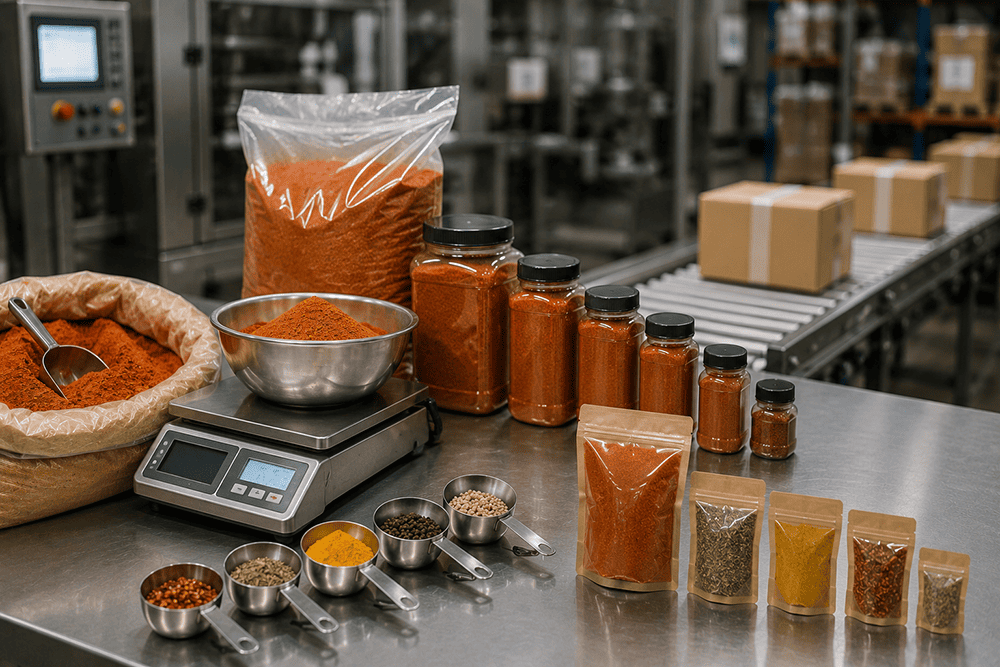
Spice and seasoning manufacturers live in two units of measure at once. Raw material arrives and is processed in bulk – kilograms, pounds, or drums of whole or ground product. That same material then has to become dozens, sometimes hundreds, of retail-ready SKUs: gram sachets, ounce jars, pound bags, bulk foodservice tubs, and private-label configurations built to a specific customer’s packaging spec.
Every one of those conversions involves more than simple math. Grinding and blending introduce yield loss. Packaging materials carry their own bill of materials and cost. And because a single bulk lot often becomes the source for many different finished pack sizes, keeping cost, yield, and traceability accurate across all of them is a genuinely complex operational problem – one that spreadsheets and manual unit conversion were never built to handle at scale.
Where Multi-UOM Complexity Creates Risk
Ask a spice manufacturer’s operations or finance team where unit-of-measure conversion causes the most pain, and a familiar set of issues comes up:
- Inconsistent conversion factors – the same item’s bulk-to-retail conversion factor gets re-entered, and sometimes re-typed incorrectly, across purchasing, production, and sales documents.
- Untracked yield and shrinkage – grinding, blending, and packaging loss is rarely captured transaction by transaction, so true conversion yield is only estimated after the fact, if at all.
- Costing errors – without an accurate yield-adjusted cost roll-up, the margin reported on a specific retail pack size can be significantly off from reality.
- Private label and co-pack complexity – a single bulk lot frequently needs to become several different customer-specific pack configurations, each with its own label, case pack, and cost structure, which is difficult to manage without a system built for it.
- Inventory unit mismatches – purchasing tracks material in kilograms, production works in pounds, and sales quotes in ounces or cases, creating friction and rework every time inventory crosses a functional boundary.
What Native Multi-UOM Support Looks Like in an ERP
An ERP built to handle multi-UOM conversion natively, such as Acumatica, treats unit-of-measure relationships as core item data rather than something reconstructed manually at each transaction. In practice, that means:
- A base unit of measure defined once per item, with conversion factors to every purchasing, production, and sales unit configured directly on the item record.
- Automatic cost roll-up as bulk material converts into retail packs, incorporating actual yield rather than an assumed conversion rate.
- A single item structure that supports multiple finished pack configurations, each tied to its own bill of materials, without duplicating master data.
- Real-time yield tracking during conversion and packaging runs, so shrinkage is visible transaction by transaction instead of discovered at month-end.
- Lot genealogy that automatically links every retail-pack lot back to its originating bulk lot, preserving full traceability through the conversion process.
Manual UOM Conversion vs. Unified ERP-Native Multi-UOM Management
| Operational Area | Manual, Spreadsheet-Based UOM Conversion | Unified ERP-Native Multi-UOM Management |
| Conversion Accuracy | Conversion factors re-entered by hand for each SKU; easy to mistype or duplicate | Conversion factors defined once per item and applied automatically everywhere |
| Costing Accuracy | Retail pack cost estimated after the fact, often missing actual yield loss | Cost rolls up automatically from bulk lot cost plus actual conversion yield |
| Private Label Flexibility | Each customer pack configuration managed as a separate manual process | One bulk lot flexibly allocated across multiple pack configurations and labels |
| Lot Traceability | Link between bulk lot and finished retail lots tracked manually, if at all | Lot genealogy automatically preserved from bulk receipt through every retail pack |
| Time to Launch a New Pack Size | New SKU setup requires manually building costing and conversion logic from scratch | New pack sizes configured in minutes using existing item and UOM structure |
Built-In Quality Control Through Every Conversion
Bulk-to-retail conversion is also where quality risk concentrates for spice manufacturers – moisture content, purity, and potency need to be verified at bulk receiving, and fill weight, seal integrity, and labeling need to be verified again at retail pack-out. eWorkplace Apps’ Quality Management Suite, built natively within Acumatica, extends quality control across both of those checkpoints without requiring a separate system.
Incoming inspections at bulk receiving can be configured with pass/fail criteria specific to purity and potency testing, while pack-out inspections verify fill weight and packaging integrity before finished goods are released to inventory. If either checkpoint uncovers an issue, the system supports lot disposition decisions and routes the event into a formal CAPA or NC process – tied directly to the same bulk and retail lot data already captured through the conversion transactions.
The result is a quality process that follows the product through conversion rather than treating bulk and retail inspection as disconnected steps handled in separate systems.
Pack Configuration Speed as a Competitive Advantage
It’s worth stepping back from the operational mechanics to consider what accurate, fast bulk-to-retail conversion actually enables commercially. Retail buyers and private-label customers increasingly expect spice and seasoning suppliers to move quickly – launching a new blend in a new pack size, responding to a retailer’s specific packaging requirement, or scaling a promotional SKU on short notice.
A manufacturer that can configure a new pack size in a system rather than rebuild costing and conversion logic by hand has a genuine speed advantage when a customer opportunity has a tight timeline. That speed advantage compounds over a growing private-label and co-pack portfolio, where the number of unique pack configurations a single bulk lot needs to support keeps expanding.
Conversely, a manufacturer still relying on manual conversion tracking often finds that operational friction, not production capacity or ingredient sourcing, becomes the real constraint on how much private-label and co-pack business it can take on. Unified multi-UOM management removes that constraint, turning pack configuration flexibility into a capability the sales team can actually sell against.
What This Means for the Bottom Line
Bringing bulk-to-retail conversion under native multi-UOM management changes what spice and seasoning manufacturers can see and control:
- Accurate margin visibility for every individual pack size, based on real yield rather than assumed conversion rates.
- Reduced overpack and giveaway, since fill weights and conversion yield are tracked and monitored transaction by transaction.
- Faster new SKU and private-label launches, since new pack configurations reuse existing item and UOM structure instead of being built from scratch.
- Cleaner scalability for co-pack and private-label growth, without a proportional increase in manual administrative work.
- A complete, audit-ready traceability record connecting every retail pack back to its originating bulk lot.
For spice and seasoning manufacturers where product complexity is measured in pack sizes as much as in SKU count, unified multi-UOM conversion is one of the clearest paths to protecting margin while supporting continued packaging and private-label growth.
Signs Your Conversion Process Has Outgrown Manual Methods
Bulk-to-retail conversion complexity tends to build up gradually as a spice manufacturer adds pack sizes and private-label customers. A few recurring patterns are reliable signals that manual, spreadsheet-based conversion has reached its limit:
- Margin by pack size is estimated rather than known with confidence, and finance routinely flags discrepancies between projected and actual cost.
- Launching a new pack size or private-label configuration takes days of manual setup rather than a quick configuration change.
- Yield and shrinkage are only discovered during physical inventory counts, well after the conversion run that caused them.
- Tracing a customer complaint about a specific retail pack back to its originating bulk lot requires digging through multiple disconnected records.
- Co-pack or private-label growth feels disproportionately burdensome to administer relative to the actual production volume involved.
Each of these points to the same underlying gap: unit-of-measure conversion is being handled as a series of manual workarounds rather than as core, structured item data the system understands and applies consistently.
What an Implementation Actually Involves
Moving from manual UOM conversion to a unified ERP-native approach is a more contained project than it might first appear, particularly when the implementation partner has direct experience with spice, seasoning, and bulk-to-retail packaging operations.
A typical implementation begins by cataloging existing bulk and retail item configurations, along with the conversion factors, packaging bills of materials, and yield assumptions currently in use – often scattered across spreadsheets and individual employees’ knowledge. That information is then structured into the ERP’s item master, with base units of measure and conversion factors defined once per item and validated against historical production data before go-live.
Packaging configurations for existing customers and private-label programs are built out as reusable templates, so future pack-size additions can be configured quickly rather than built from scratch. Running new conversion transactions in parallel with existing manual tracking for a short period allows the operations team to validate yield calculations and costing before fully retiring spreadsheet-based methods.
Turn Every Bulk Lot Into Accurate Retail Packs
Acuvera Tech helps spice and seasoning manufacturers implement Acumatica ERP with native multi-UOM conversion, so bulk-to-retail packaging finally has accurate costing and full traceability. Talk to our team to see how unified UOM management fits your operation.