
What Is ERP- and Why Every North American Manufacturer Needs to Be Paying Attention Right Now
There’s a question manufacturers keep asking, but this is the one they should be asking instead.
Most manufacturers who reach out to us start with some version of the same question: “Is now really the right time to invest in new technology?”
It’s a fair question. ERP has been around for decades. The pitch hasn’t changed much. And for a lot of manufacturers, a previous implementation may have left a bad taste, whether that was over budget, over schedule, and underdelivered.
But here’s what’s different in 2026: the question is no longer whether ERP is worth it. The question is whether your current operation can survive without it.
Because the manufacturers who are pulling ahead right now aren’t just running leaner. They’re running smarter and powered by technology that learns, adapts, and makes their entire operation more intelligent with every passing day.
So what exactly is ERP – and why does it matter now?
ERP stands for Enterprise Resource Planning. At its core, it’s a single, integrated system that connects every part of your business from production, inventory, purchasing, finance, customer orders, and your workforce into one source of truth.
Instead of your operations manager calling the warehouse to check stock while your estimator is building a quote in a spreadsheet that won’t match what actually ships, everyone in the business is working from the same real-time data, at the same time.
For manufacturers, that means:
· No more job costing surprises. You know what a job is actually costing you while it’s still on the floor instead of three weeks later when the invoice is already out.
· No more inventory guesswork. You know what you have, where it is, and what you need to order before a line goes down.
· No more end-of-month chaos. Financial close happens in days, not weeks, because the data is already there.
· No more tribal knowledge risk. When your best estimator retires or your warehouse lead moves on, the institutional knowledge stays in the system, and not in someone’s head.
That’s what ERP does at its most fundamental level. But in 2026, what ERP can do has changed the conversation entirely.
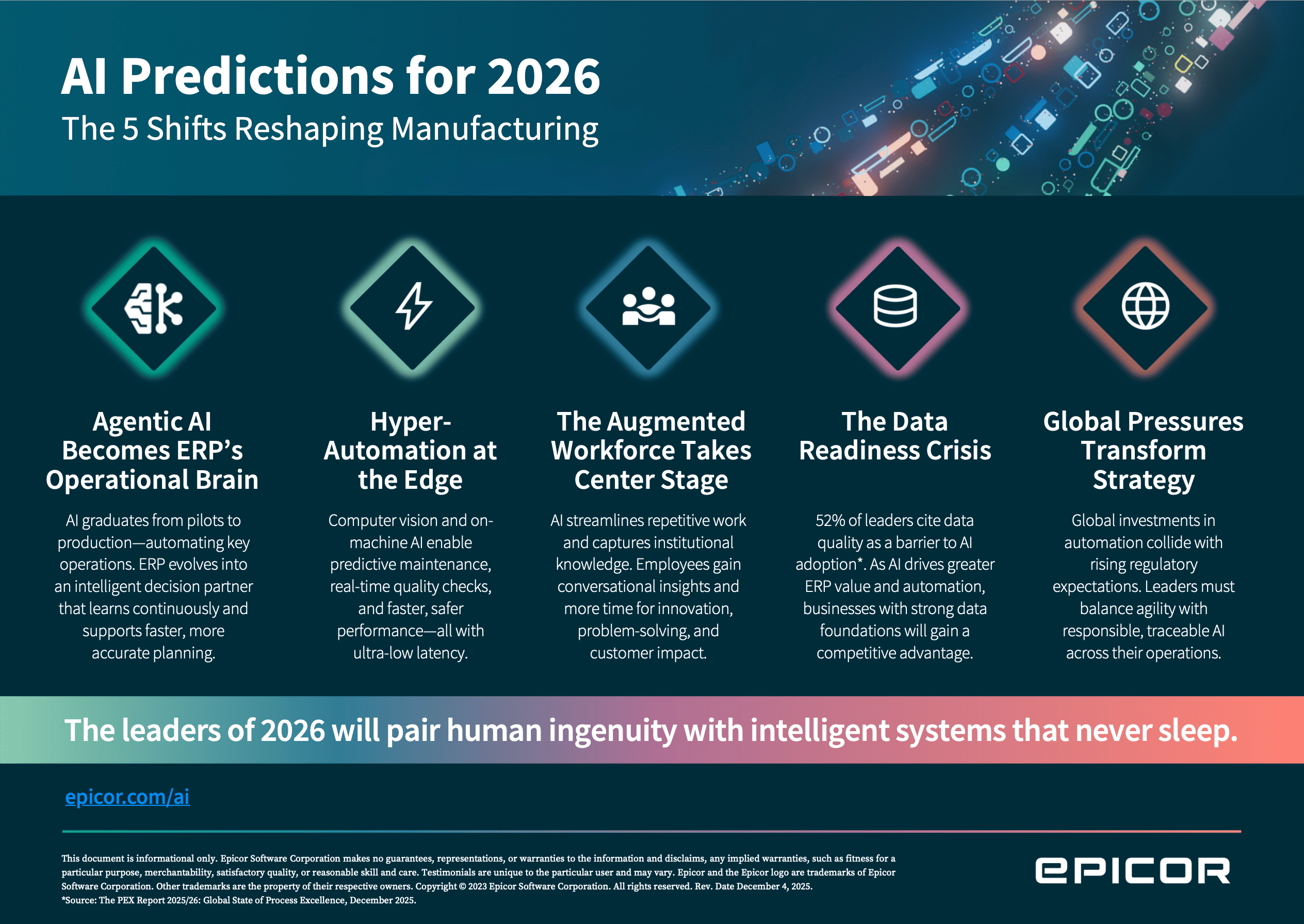
The 5 shifts that change everything for manufacturers this year
Epicor recently released its AI Predictions for 2026, and for manufacturers still weighing whether now is the right time to modernize, this research is worth taking seriously. Here’s what it means in plain language for your operation:
1. Agentic AI becomes ERP’s operational brain
AI is no longer a feature bolted onto the side of your software. In 2026, AI is being embedded directly into ERP as an active decision-making partner. Now it’s analyzing patterns, flagging anomalies, and recommending actions before problems escalate.
For manufacturers, this means your ERP system can learn how your operation runs and start supporting decisions that used to rely entirely on experience and instinct. Faster planning. More accurate forecasting. And an operation that gets smarter the longer you use it.
2. Hyperautomation at the edge
Computer vision and on-machine AI are making predictive maintenance and real-time quality control a reality on the shop floor, not some research project. The manufacturers investing in connected ERP now are building the infrastructure that makes these capabilities possible. Those still on disconnected systems are building a gap that gets harder to close every quarter.
3. The augmented workforce takes center stage
One of the most persistent fears around technology in manufacturing is that it replaces people. The data tells a different story. AI in ERP is eliminating the repetitive, low-value tasks that burn out good employees, such as data entry, manual reporting, and chasing down information that should already be visible. What it gives back is time: for problem-solving, for customer relationships, for the kind of work that actually requires human judgment.
For manufacturers facing workforce challenges, this isn’t a nice-to-have. It’s a retention and productivity strategy.
4. The data readiness crisis
This one is the most important stat in Epicor’s 2026 research, and it’s worth quoting directly: 52% of business leaders cite data quality as their biggest barrier to AI adoption.
That number should concern any manufacturer still running on spreadsheets, legacy systems, or disconnected software. The businesses gaining competitive advantage from AI are the ones with clean, connected, real-time data at their foundation. ERP is that foundation. Without it, every AI capability on the horizon stays out of reach.
5. Global pressures are transforming strategy
Supply chain volatility, rising regulatory expectations, and increasing automation investment from global competitors are forcing North American manufacturers to make a choice: modernize deliberately, or react expensively. The manufacturers treating technology investment as a strategic decision, rather than a last resort, are the ones building operations resilient enough to handle whatever comes next.
What this means for your operation right now
The timing argument for ERP used to be “eventually.” In 2026, eventually has already arrived.
The manufacturers who will lead in the next three to five years are making infrastructure decisions today. Those are the ones who understand that the gap between operations built on real-time data and operations still running on institutional knowledge and spreadsheets is widening every single month.
At Acuvera Tech, we work exclusively with manufacturers and distributors. We implement Epicor Kinetic, one of the most powerful manufacturing ERP platforms available for operations just like yours. We specialize in mid-size manufacturers who are serious about building something that lasts.
We’re not here to sell you software. We’re here to make sure the right technology actually works for the way your business runs.
Ready to see what this looks like for your operation?
We’ve put together the complete Epicor for Manufacturing guide: a practical, no-fluff look at what modern ERP delivers for manufacturers, what an implementation actually involves, and how to evaluate whether the timing is right for your business.
It’s the resource we wish every manufacturer had before they started asking the wrong questions.
Acuvera Tech is an Epicor partner specializing in ERP implementation for manufacturing and distribution. We implement Epicor Kinetic and Prophet 21 for mid-size operations across North America. Have questions before you’re ready to download?