
The Hidden Cost of Multi-Temperature Warehousing: Why Frozen Food Manufacturers Need a Unified ERP Approach
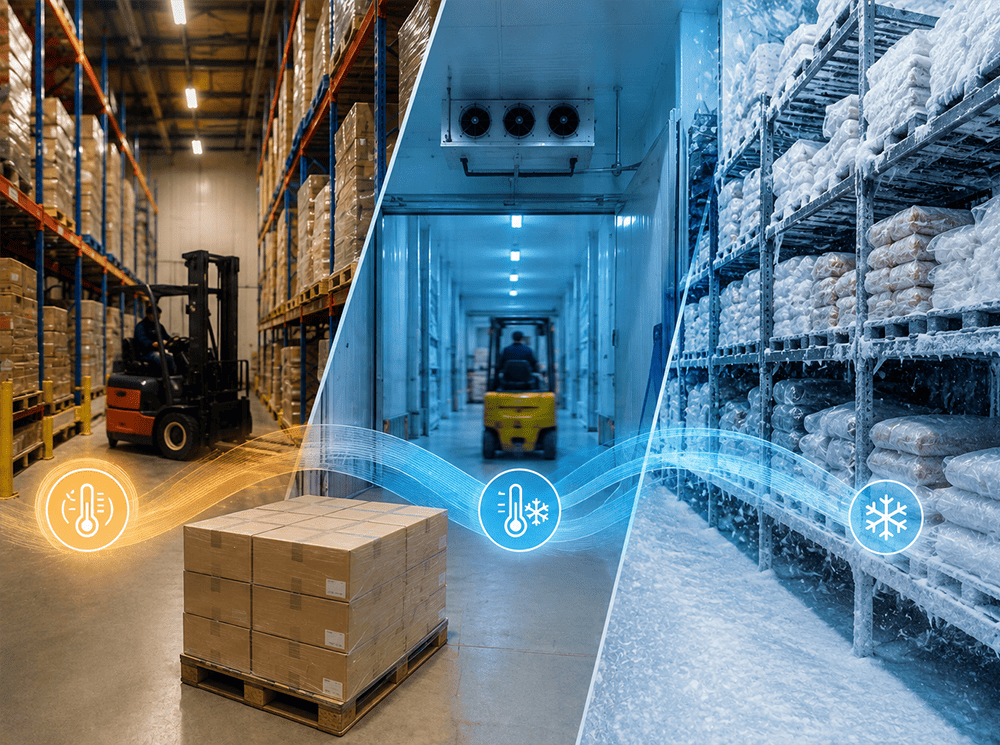
One Warehouse, Three Temperature Worlds
Most frozen food manufacturers assume their biggest operational challenge is the freezer. In practice, the freezer is only one-third of the problem. Raw ingredients often sit at ambient temperature, work-in-process or certain finished items require refrigeration, and only the final frozen product needs deep-freeze storage. A single facility, or a tightly linked pair of facilities, ends up managing three distinct temperature environments, each with its own handling rules, shelf-life sensitivity, and regulatory expectations.
When the systems running that facility were never designed to understand the difference between a freezer zone, a chiller zone, and a dry zone, the complexity does not disappear – it just moves onto the shop floor, where it shows up as wasted product, mispicks, and stressed warehouse teams trying to hold the operation together manually.
Where the Complexity Actually Bites
Ask any operations manager running a multi-temperature frozen food warehouse where the pain shows up, and the list is remarkably consistent:
• Fragmented inventory visibility – frozen, chilled, and ambient stock often live in separate spreadsheets or disconnected system modules, so no one has a single real-time view of total inventory.
• Zone-blind putaway – without system-enforced rules, staff decide by memory or habit where a pallet belongs, and mistakes routinely send product to the wrong zone.
• Picking inefficiency – order pickers cross zones repeatedly to fulfill a single order, increasing travel time and the number of freezer door openings, which itself accelerates product degradation.
• Reconciliation lag – many operations rely on nightly manual counts to true up frozen versus chilled versus dry inventory, delaying visibility into shortages or overages.
• Compliance exposure – temperature excursion events and zone transfers are frequently logged on paper, making it difficult to produce a complete, defensible record during a customer or regulatory audit.
• Higher cost to serve – the cumulative effect of rework, overtime, and spoilage quietly erodes margin in a category that already operates on thin ones.
Why Generic Systems Don’t Solve This
Generic ERP platforms and basic warehouse add-ons tend to treat a warehouse as one flat, undifferentiated space. They track quantity and location as simple data fields, but they don’t inherently understand that a pallet of finished goods belongs in freezer zone F3 while a pallet of packaging material belongs in ambient zone A1 – and that violating that distinction has real product-safety and shelf-life consequences, not just a bookkeeping inconvenience.
Without zone-aware logic built into the core system, companies patch the gap with tribal knowledge, laminated zone maps taped to forklifts, and manual double-checks. That approach can work at small volume. It breaks down quickly as SKU count, order volume, or facility footprint grows, and it leaves the business dependent on a handful of experienced employees who know the workarounds.
What Zone-Aware, ERP-Native Warehouse Management Looks Like
An ERP-native warehouse management approach, such as the WMS functionality built into Acumatica, treats temperature zones as first-class data – not an afterthought layered on top. In practice, that means:
• Zone- and location-based license plating, so every pallet or case is tied to a specific temperature-controlled location, not just a generic bin.
• Directed putaway and pick logic that automatically routes staff to the correct zone based on the item’s storage requirements, removing guesswork.
• A single, real-time inventory ledger spanning frozen, chilled, and ambient stock, eliminating the need to reconcile separate spreadsheets or subsystems.
• Mobile RF scanning that enforces zone rules at the point of transaction, flagging or blocking moves that would place product in the wrong environment.
• Full integration with production, quality, and finance, so a single system of record captures the physical movement of inventory and its financial and quality implications together.
The result is not just cleaner data – it’s a warehouse where the system actively prevents the errors that used to depend on someone remembering the rules correctly.
Manual Multi-Temp Management vs. Unified ERP-Native Management
|
Operational Area |
Manual, Siloed Multi-Temp Management | Unified ERP-Native Management |
| Inventory Visibility | Separate spreadsheets or systems per zone; no single real-time view | One ledger showing frozen, chilled, and ambient stock in real time |
| Putaway Accuracy | Staff judgment decides storage location; frequent misplacement | System-directed putaway enforces the correct temperature zone every time |
| Picking Efficiency | Pickers cross zones repeatedly, increasing travel time and door openings | Zone-optimized pick paths minimize travel and limit temperature exposure |
| Compliance Documentation | Paper logs and manual reconciliation; slow, incomplete audit trails | Automatic, timestamped records tied to every zone transaction |
| Cost to Serve | Waste, rework, and overtime absorb margin quietly over time | Lower shrinkage and labor cost through accuracy and automation |
Built-In Quality Control for Every Zone
Temperature transitions are exactly where frozen food quality risk concentrates – receiving into the wrong zone, a delayed transfer between chiller and freezer, or a hold that isn’t documented consistently. This is where eWorkplace Apps’ Quality Management Suite, built natively within Acumatica, extends the value of a unified system even further.
Rather than bolting on a separate quality application, eWorkplace Apps adds QC workflows directly inside the same platform managing inventory and warehouse operations. Incoming inspections can be triggered automatically as product is received into a given zone, with pass/fail criteria specific to that temperature environment. When an inspection uncovers an issue – a temperature excursion, a packaging defect, a supplier nonconformance – the system supports lot disposition decisions and routes the event into a formal CAPA (Corrective and Preventive Action) or NC (Nonconformance) process, all tied back to the same lot and location data already captured by the warehouse module.
For frozen food manufacturers, this means quality control isn’t a separate system someone has to remember to update – it’s embedded in the same transactions that move product between zones, closing the gap between operations and quality assurance.
What This Means for the Bottom Line
Bringing frozen, chilled, and ambient inventory under one ERP-native system changes the economics of running a multi-temperature warehouse:
• Reduced spoilage and shrinkage from fewer misplacements and shorter freezer door exposure times.
• Lower labor cost per order through optimized, zone-aware pick paths.
• Faster, more defensible audits with automatic, timestamped compliance records.
• Quicker month-end close, since inventory across all zones reconciles in real time rather than through manual counts.
• A system that scales with the business, rather than one that depends on a few employees who know the workarounds.
For frozen food manufacturers weighing where to invest next in operational improvement, unifying multi-temperature warehouse management inside a single ERP platform is one of the few changes that pays back across quality, labor, and compliance simultaneously.
Signs Your Operation Has Outgrown Manual Multi-Temp Management
Not every frozen food operation needs to overhaul its warehouse systems immediately, but certain patterns tend to signal that manual, siloed processes have reached their limit. If any of the following sound familiar, the gap between current systems and actual operational complexity is likely already costing more than it appears to on paper:
• Physical inventory counts routinely turn up discrepancies between what the system says and what is actually on the shelf in a given zone.
• Supervisors spend a meaningful part of their day manually reassigning putaway locations because staff placed product in the wrong zone.
• Customer or regulatory audits require someone to manually assemble temperature and lot records from multiple sources rather than pulling a single report.
• New hires take weeks to learn zone rules because the knowledge lives with experienced staff rather than in the system itself.
• Adding a new product line or expanding into a new temperature category feels disproportionately disruptive relative to the size of the change.
Each of these is a symptom of the same underlying issue: the system running the warehouse doesn’t actually understand temperature zones as a core part of how inventory moves. Recognizing the pattern early makes it far easier to address before volume growth or a new customer contract forces the issue.
What an Implementation Actually Involves
Moving from manual, siloed multi-temp management to a unified ERP-native approach is not an overnight switch, but it is also far less disruptive than most operations teams expect – particularly when the implementation partner has direct experience with frozen food and cold chain operations rather than treating it as a generic warehouse project.
A well-run implementation typically starts by mapping existing zones, storage rules, and picking patterns in detail, so the system configuration reflects how the facility actually operates rather than a generic template. From there, location and license plate structures are built to match the physical layout, directed putaway and picking rules are configured around each zone’s requirements, and mobile scanning devices are rolled out to enforce those rules at the point of transaction. Historical inventory data is migrated and reconciled against a physical count, so the new system starts with accurate, trusted numbers rather than inherited discrepancies.
Throughout this process, running the new system in parallel with existing methods for a limited period allows warehouse staff to build confidence before fully cutting over, reducing the risk of disruption during a transition that touches daily operations directly.
Bring Every Temperature Zone Under One System
Acuvera Tech helps frozen food manufacturers implement Acumatica ERP with zone-aware warehouse management, so frozen, chilled, and ambient inventory finally live in one accurate system. Talk to our team to see how a unified warehouse approach fits your operation.