
ERP for Food Manufacturers: Cutting Waste and Meeting Compliance
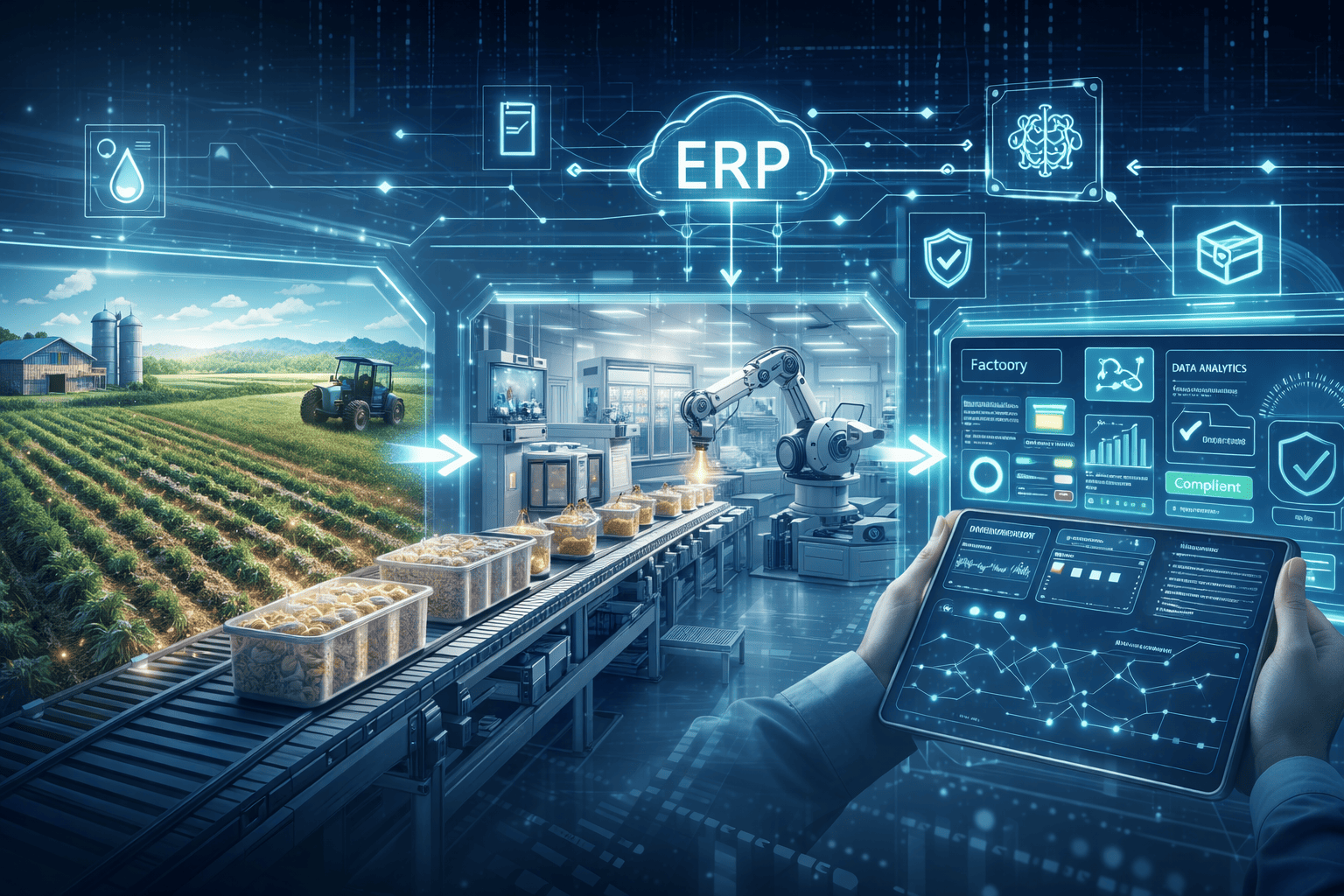
For food and beverage manufacturers, the margin for error is razor-thin – and getting thinner. Rising input costs, tightening regulatory requirements, and increasingly complex supply chains are putting pressure on operations at every level. Yet many mid-market F&B companies are still running on disconnected systems, manual spreadsheets, or legacy software that simply was not built for today’s demands.
Modern ERP platforms are changing that. When implemented correctly, an ERP system designed for food and beverage operations doesn’t just replace spreadsheets – it becomes the operational backbone that drives traceability, reduces waste, and keeps your business audit-ready at all times.
The Compliance Challenge Is Only Getting Harder
The Food Safety Modernization Act (FSMA) fundamentally shifted the regulatory environment for food manufacturers in the United States – moving the industry from reactive recall management to proactive risk prevention. Combined with ongoing requirements from the FDA, USDA, and increasingly demanding retail and foodservice customers, compliance is now a permanent operational function, not a periodic audit exercise.
The challenge? Compliance requires data – clean, traceable, time-stamped data about every ingredient that enters your facility and every product that leaves it. Without a modern ERP system, generating that data at scale is expensive, error-prone, and slow.
A purpose-built food and beverage ERP provides:
• Lot and batch traceability from raw material receipt through finished goods shipment
• Automated allergen management and cross-contamination controls
• Certificate of analysis (COA) tracking and supplier compliance documentation
• Recall readiness – the ability to trace a suspect lot forward or backward within minutes, not days
Waste Is a Profitability Problem – and ERP Is the Solution
Food waste represents one of the largest hidden costs in F&B manufacturing. Expired raw materials, over-production, yield variances, and spoilage in cold storage all erode margins that are already thin. Most mid-market manufacturers know waste is happening – but without real-time visibility into inventory and production, it’s nearly impossible to pinpoint where.
Modern ERP platforms bring waste reduction into focus by connecting purchasing, production, and inventory in a single system. With accurate demand forecasting, dynamic reorder points, and lot expiration date management, manufacturers can dramatically reduce write-offs and optimize raw material utilization.
Beyond inventory, ERP helps manufacturers track yield at each production stage – identifying where product is being lost and enabling continuous improvement in recipes, batch sizes, and equipment performance.
Real-Time Visibility Across the Entire Operation
One of the most transformative benefits of modern ERP for food and beverage manufacturers is real-time operational visibility. When production, inventory, quality, and financials are managed in a single integrated system, leadership and plant managers can see exactly what is happening – not what happened last week.
This visibility enables faster, better decisions:
• Know your true cost of production by product, batch, or customer order
• See live inventory positions across multiple warehouses or co-manufacturers
• Monitor production schedules and flag bottlenecks before they become delays
• Track customer order status from commitment to shipment in real time
For companies managing seasonal demand swings, promotional periods, or private label production for major retailers, this kind of real-time data is the difference between confident execution and firefighting.
Choosing the Right ERP Partner Matters
Not every ERP platform is suited for food and beverage manufacturing. The industry has specific requirements around lot traceability, catch-weight management, shelf-life tracking, and production scheduling that generic ERP platforms often struggle to address without heavy customization.
Platforms like Acumatica have built-in capabilities for food and beverage operations, including native lot/serial traceability, flexible inventory costing, and integration-ready architecture for connecting to quality management, EDI, and warehouse management systems. But the platform is only part of the equation – the implementation partner you choose determines how well those capabilities translate to your specific operation.
An experienced ERP partner brings more than technical knowledge. They bring deep familiarity with F&B workflows, realistic timelines, and the ability to configure the system around how your business actually operates – not a generic out-of-the-box setup.
What to Look for in Your ERP Evaluation
If you are evaluating ERP systems for your food and beverage operation, here are the capabilities that should be non-negotiable:
• Forward and backward lot traceability with full audit trail
• Expiration date and FEFO (First Expired, First Out) inventory management
• Recipe and formula management with yield tracking
• Quality hold and release workflows integrated with production
• Compliance reporting and document management for FDA/FSMA readiness
• Integration capability with WMS, EDI, and customer portals
Ready to Modernize Your F&B Operations?
Acuvera Tech has deep experience helping food and beverage manufacturers implement ERP solutions that drive compliance, reduce waste, and improve operational visibility. If you’re evaluating your options or ready to start a conversation, we’d welcome the opportunity to learn about your operation.