
AI-Powered ERP: What Every Manufacturer Needs to Know in 2026
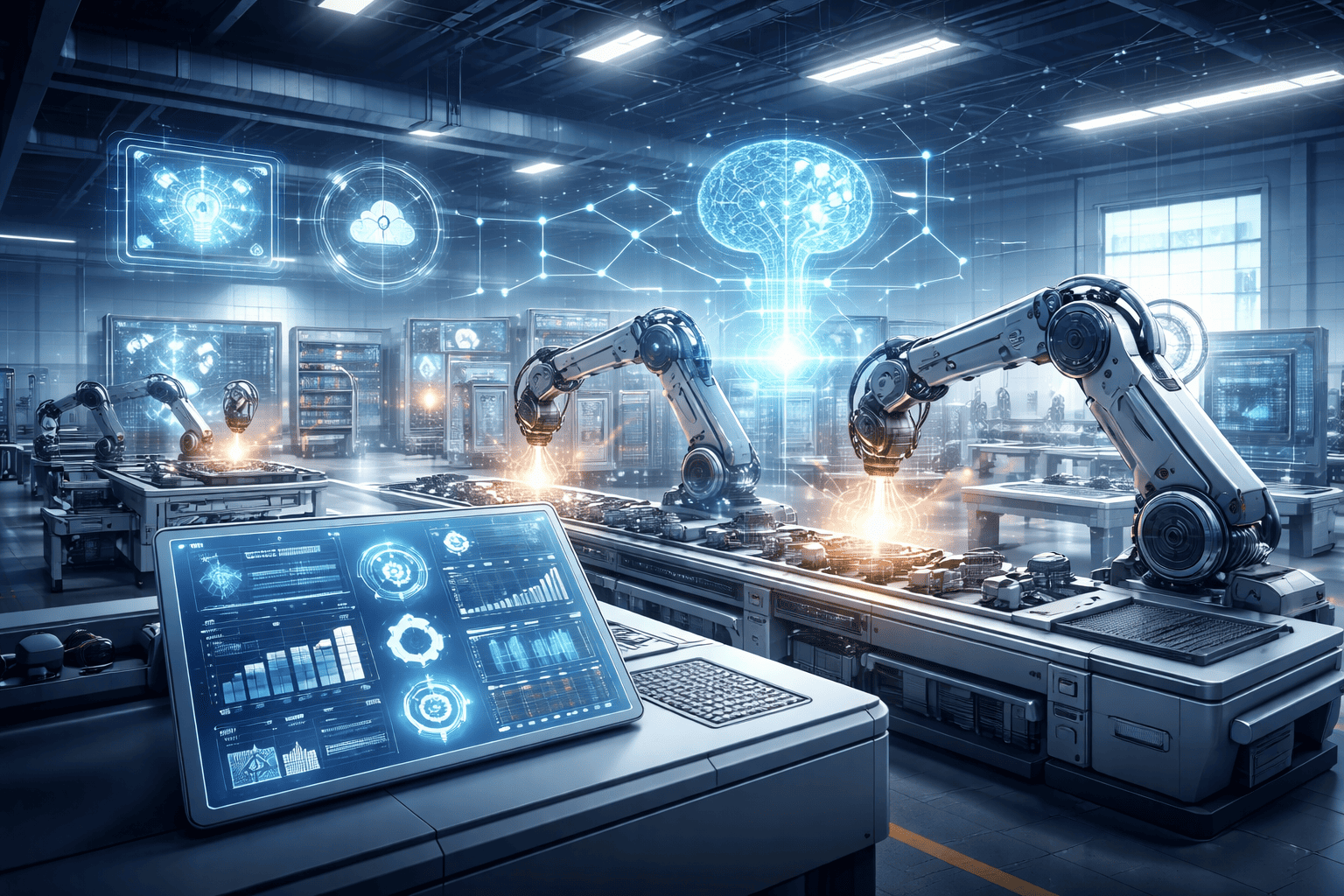
Manufacturing has always rewarded efficiency. But in 2026, the definition of efficiency itself is being rewritten – and the engine driving that change is artificial intelligence embedded directly into Enterprise Resource Planning systems.
According to a 2026 survey by Rootstock Software, 94% of manufacturers are now using or actively exploring AI in their operations. That number signals something important: AI in manufacturing ERP is no longer a leading-edge experiment. It is becoming the baseline expectation for competitive operations.
Yet despite widespread interest, adoption remains uneven. Many manufacturers find themselves caught between enthusiasm for AI’s potential and the very real constraints of legacy systems, data silos, and unclear implementation paths. This post cuts through the noise – explaining what AI-powered ERP actually means, what it can realistically deliver, and what separates manufacturers who are capturing its value from those who are not.
What Does “AI-Powered ERP” Actually Mean?
The term gets used loosely, so it is worth being precise. AI-powered ERP refers to enterprise resource planning systems that incorporate artificial intelligence and machine learning capabilities – either natively within the platform or through deep integrations with AI tools – to move beyond recording and reporting what happened, toward predicting, recommending, and in some cases automating what should happen next.
Traditional ERP systems are fundamentally transactional. They capture purchase orders, track inventory movements, record production completions, and generate financial entries. They are essential – but reactive. AI changes the paradigm by layering intelligence on top of that transactional backbone, enabling the system to learn from patterns, surface anomalies, model scenarios, and generate insights that a traditional ERP simply cannot produce.
Industry analysts describe this shift as the transition from a “system of record” to a “system of action” – and for manufacturers navigating volatile supply chains, rising cost pressures, and increasing customer complexity, the distinction is enormously consequential.
5 Ways AI Is Reshaping Manufacturing ERP Right Now
1. Predictive Maintenance
Unplanned equipment downtime remains one of the largest hidden costs in manufacturing. AI-driven predictive maintenance changes the economics by connecting IoT sensor data from the shop floor – machine temperature, vibration, cycle counts, energy draw – directly into the ERP, where machine learning models analyze patterns and flag potential failures before they occur.
Rather than servicing equipment on a fixed schedule – which often means servicing it too early or too late – manufacturers shift to condition-based maintenance driven by actual machine behavior. The ERP automatically triggers parts procurement, books maintenance windows during low-impact production periods, and updates maintenance records without manual intervention. Early adopters are reporting double-digit reductions in unplanned downtime and meaningful savings in maintenance costs.
2. Autonomous Supply Chain Planning
Supply chains in 2026 are operating under sustained pressure. According to Rootstock’s survey, 39% of manufacturers expect higher raw material costs driven by tariffs, with 29% facing greater difficulty in cost forecasting. AI-powered supply chain planning addresses this directly by moving from periodic analysis to continuous, real-time modeling.
When a supplier signals a potential delay, or freight data indicates a bottleneck forming at a key port, an AI-integrated ERP does not simply send an alert. It evaluates alternative suppliers, models the cost and lead time tradeoffs, adjusts purchase orders, and rebalances inventory positions – all within guardrails defined by the operations team. The result is a supply chain that responds to disruption in hours rather than days.
3. Dynamic Production Scheduling
Production scheduling has traditionally been one of the most complex – and most manually intensive – disciplines in manufacturing. Balancing machine capacity, material availability, workforce constraints, and shifting order priorities is a dynamic problem that static scheduling tools handle poorly.
AI transforms this into a continuously optimized process. When disruptions occur – a late inbound shipment, an unexpected machine issue, a rush order from a key account – the system models the impact across the production schedule and surfaces the optimal response in real time. Computer vision capabilities are also enabling automated quality inspection on the line, catching defects at source rather than at final testing, reducing rework costs and improving throughput.
4. Intelligent Demand Forecasting
Inventory has always been a delicate balance: too much ties up working capital and inflates carrying costs; too little means missed orders and strained customer relationships. Traditional forecasting methods – typically based on historical averages and manual adjustments – struggle in environments characterized by volatile demand, short product lifecycles, and multi-channel complexity.
Machine learning-based forecasting models analyze a far richer set of inputs: historical sales at the SKU level, market signals, promotional calendars, weather patterns, and macroeconomic indicators. The result is significantly more accurate demand projections, enabling smarter inventory positioning, reduced carrying costs, and higher service levels – simultaneously.
5. Agentic AI: From Recommendations to Action
The leading edge of AI in ERP in 2026 is what technology analysts are calling “agentic” AI – systems that move beyond surfacing recommendations and begin taking actions autonomously, within defined operational parameters. Instead of a planner querying the ERP for information, software agents proactively monitor conditions, evaluate options, and execute decisions: reordering inventory, rerouting production, triggering maintenance requests, notifying customers of delivery changes.
For operations leaders, this represents a meaningful shift in how time is spent – from initiating and entering transactions to reviewing, approving, and refining a queue of actions already proposed or completed by AI agents. It is early-stage for most manufacturers, but the trajectory is clear and the productivity implications are significant.
Why Most Manufacturers Are Not Capturing AI’s Value Yet
With 94% of manufacturers exploring AI, why are only a fraction reporting meaningful results? The answer is almost always the same: infrastructure.
AI models require real-time, high-quality, unified data to function effectively. When ERP, MES, WMS, and supply chain systems are operating in silos – sharing information through manual processes, batch exports, or disconnected point solutions – the integrated data environment that AI depends on does not exist. The AI tools may be sophisticated, but they are working with incomplete or stale information, and the results reflect that.
A 2026 manufacturing technology survey found that while 98% of manufacturers are exploring automation and AI, only 20% feel fully prepared to deploy it effectively. The gap is not willingness to invest – it is the state of the underlying technology environment.
This is why the ERP platform decision is so consequential. A modern, cloud-native ERP with an open integration architecture and a unified data model does not just solve today’s operational challenges – it creates the foundation that makes every subsequent AI investment more productive and more reliable.
What to Look for in an AI-Ready ERP Platform
Not all ERP platforms are positioned equally for AI integration. When evaluating whether your current system – or a platform under consideration – can support the direction manufacturing technology is heading, these are the capabilities that matter:
• Cloud-native architecture – delivering continuous updates, elastic scalability, and frictionless integration with AI tools and external data sources, without the constraints of on-premise infrastructure
• Unified data model – a single source of truth across finance, procurement, production, inventory, and customer management that eliminates the data silos preventing AI from operating with full operational context
• Open API and integration framework – enabling AI tools, IoT systems, and third-party platforms to connect cleanly, without heavy custom development
• Industry-specific depth – purpose-built functionality for manufacturing, distribution, and related sectors that reflects real operational workflows rather than generic business processes
• Composable, modular design – allowing organizations to deploy AI-enhanced capabilities in targeted areas, at a pace that matches their readiness, rather than requiring wholesale system replacement
Platforms like Acumatica ERP are designed around these principles – cloud-native, modular, deeply integrated, and purpose-built for manufacturers and distributors across industries from food and beverage to industrial manufacturing and construction.
The Manufacturers Winning With AI Have One Thing in Common
Across industries and geographies, the manufacturers realizing the most value from AI-powered ERP share a common trait: they invested in getting their operational foundation right before layering AI on top of it. They migrated from fragmented, legacy environments to modern, connected ERP platforms. They standardized processes, unified data, and established the real-time visibility that intelligent decision-making requires.
The sequence matters. AI amplifies the quality of the data and processes it works with. A well-implemented modern ERP multiplies the impact of every AI tool deployed on top of it. A fragmented legacy environment limits returns regardless of how sophisticated the AI.
For manufacturers assessing their current position, the right question is not simply “which AI tools should we evaluate?” It is: “Is our ERP environment ready to make those investments pay off?”
Looking Ahead: ERP as the Core of the Intelligent Enterprise
The trajectory of AI in manufacturing ERP is clear and accelerating. Predictive capabilities will become standard. Agentic AI will take on progressively more operational decisions. The line between ERP and AI platform will continue to blur as the leading systems absorb more intelligence natively.
What does not change is this: the value of any technology investment is determined by the quality of its implementation and the readiness of the environment it operates in. Manufacturers who approach AI-powered ERP with that principle – getting the platform right, implementing it rigorously, and building on a connected data foundation – will be well-positioned to compete in an industry being reshaped by intelligence.
Those who chase AI features without addressing underlying system fragmentation will find the returns elusive – and the gap with competitors widening.