
Formulation & Recipe Management: The ERP Feature Flavor and Ingredient Manufacturers Can't Operate Without
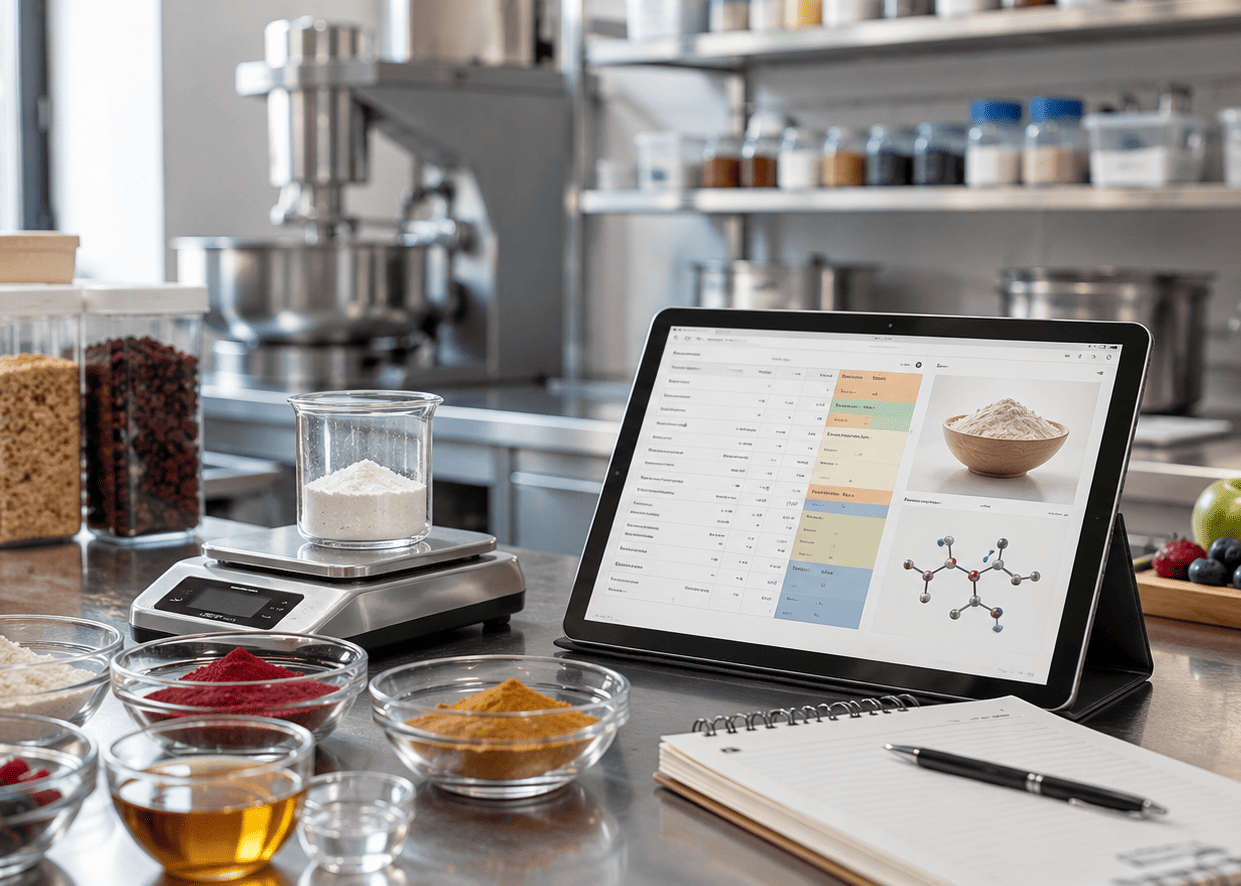
Flavor and ingredient manufacturers occupy one of the most formulation-intensive corners of the food and beverage industry. A single flavor house might maintain thousands of active formulas, each built from dozens of raw materials with varying potency, moisture content, and allergen profiles. A shift in a single supplier’s raw material assay can ripple through hundreds of finished formulas, changing yield, cost, and even regulatory labeling requirements.
For companies at this stage of growth, the formulation function is not a back-office detail. It is the core intellectual property of the business, and it deserves ERP tooling built for that reality rather than adapted from generic manufacturing templates. This blog takes a feature-level look at what formulation and recipe management should actually do inside a modern ERP platform, and why flavor and ingredient manufacturers running outgrown or generic systems are leaving accuracy, margin, and speed on the table.
Why Formulation Management Is Different for Flavors & Ingredients
Formulation in this vertical carries complexity that most discrete or even standard process manufacturing ERPs were never designed to absorb. Unlike a company producing a handful of stable SKUs, flavor and ingredient manufacturers routinely manage thousands of proprietary formulas, many of which exist in multiple versions for different customers, regions, or regulatory jurisdictions.
Raw materials themselves are rarely uniform. Natural extracts, essential oils, and specialty chemicals arrive with variable potency, moisture, and assay values from lot to lot. A formula that calls for a fixed percentage of an ingredient may need real-time adjustment based on the actual incoming material characteristics, not the standard specification on file. Add allergen tracking, kosher and halal certifications, REACH and IFRA compliance for fragrance and flavor components, and the formulation record becomes as much a regulatory document as a production instruction.
• Multi-level, nested formulas where sub-blends are themselves formulated products
• Potency and assay-based adjustments that scale ingredient quantities dynamically
• Version control across customer-specific, regional, and R&D formula variants
• Allergen, kosher, halal, and IFRA/REACH compliance data tied directly to the formula
• Complex unit-of-measure conversions between purchasing, formulation, and production units
Where Spreadsheets and Generic ERP Systems Break Down
Many flavor and ingredient companies begin with formulas managed in spreadsheets or in ERP modules designed primarily for discrete manufacturing. Both approaches tend to work until the formula library and customer base reach a certain scale, at which point the cracks become expensive.
Spreadsheet-based formulation offers no audit trail, no automatic cost rollup when raw material prices change, and no enforced version control, which means the wrong formula revision can reach the production floor. Generic ERP bill-of-materials structures, meanwhile, typically assume fixed quantities and static units of measure, which cannot accommodate potency-based scaling or the percentage-based, weight-to-volume conversions that formulation chemistry requires.
The result is a formulation process that lives partly in the ERP and partly in the heads and spreadsheets of R&D and production staff, creating exactly the kind of institutional risk that becomes visible during a customer audit, a key employee departure, or a scale-up to a new production facility.
Inside Acumatica’s Formulation & Recipe Management Capabilities
Acumatica Manufacturing Edition, configured for process and formula-based manufacturing, gives flavor and ingredient companies a formulation engine built around the realities described above rather than around discrete parts assembly.
At the center of this is native support for multi-level, nested bills of material, so a finished flavor compound can reference intermediate sub-blends, and those sub-blends can in turn reference their own formulas, with cost and quantity data flowing correctly through every level. Formula quantities can be defined by percentage of batch weight rather than fixed units, and the system automatically recalculates absolute quantities as batch size changes, eliminating manual scaling errors during production planning.
• Potency and yield-based scaling: formulas adjust ingredient quantities automatically based on incoming lot assay data, so a lower-potency raw material lot triggers a corrected formula quantity rather than a manual recalculation
• Formula version control: every revision is timestamped, attributed, and locked once released, with the ability to maintain simultaneous customer-specific or regional variants of the same base formula
• Automated cost rollups: as raw material costs fluctuate, formulated product costs update in real time, giving R&D and sales accurate margin visibility before a formula is quoted or released
• Unit-of-measure intelligence: seamless conversion between purchasing units, formulation percentages, and production batch units removes a major source of manual error
• R&D-to-production workflow: trial formulas can be developed, tested, and costed in a sandboxed R&D environment before formal release to the production formula library
Connecting Formulation to Quality: The eWorkplace Apps Advantage
Formulation accuracy only delivers full value when it is tied directly to quality verification at the point of production. This is where eWorkplace Apps, a native Acumatica Quality Management Suite, extends the formulation engine into the quality domain that flavor and ingredient manufacturers depend on most heavily.
Because eWorkplace Apps operates natively within Acumatica rather than as a bolted-on third-party system, quality checkpoints can be configured directly against formula specifications. When a batch is produced, in-process quality checks can automatically reference the assay tolerances, allergen declarations, and potency ranges defined in the formula itself, rather than requiring quality staff to cross-reference a separate document.
This connection between formulation and quality also strengthens lot disposition and CAPA (Corrective and Preventive Action) processes. If an incoming raw material lot falls outside acceptable assay range, the system can flag the affected formulas before that lot is released to production, closing a gap that exists in many generic ERP and stand-alone QMS combinations.
• Automated inspection workflows tied directly to formula-defined tolerances and specifications
• Real-time lot disposition that prevents out-of-spec raw materials from reaching formulated batches
• CAPA and non-conformance workflows linked to the specific formula and batch record affected
• A single source of truth spanning formulation, production, and quality, reducing audit preparation time
The Business Impact of Getting Formulation Management Right
For flavor and ingredient manufacturers, the return on properly implemented formulation and recipe management extends well beyond production efficiency. It touches margin protection, customer trust, and speed to market for new formulations.
• Faster new product development, with trial formulas costed and validated before committing production capacity
• Protected margins, since real-time cost rollups catch formula profitability erosion before it reaches the customer invoice
• Reduced compliance risk, with allergen, kosher, halal, and regulatory data embedded directly in the formula record rather than tracked separately
• Stronger customer confidence during audits, backed by a complete, version-controlled formulation history
• Scalability across multiple production facilities without duplicating formulation logic in spreadsheets at each site
What Migration Actually Looks Like
One of the most common objections to modernizing formulation management is the assumption that migrating thousands of active formulas out of spreadsheets or a legacy system is too disruptive to attempt. In practice, a structured migration approach treats the formula library as data to be validated and imported in stages, not as a manual re-entry project.
A phased approach typically begins with the highest-volume or highest-revenue formulas, validating that costed outputs match known production history before moving to the broader library. This allows R&D, quality, and production teams to build confidence in the new system incrementally, while continuing to run current production from existing records until each formula group is verified. Historical formula versions can be preserved as archived records, maintaining the audit trail that customers and auditors expect without forcing a hard cutover on a single date.
Raw material master data, including potency ranges, allergen declarations, and certification status, is typically migrated in parallel, since formula accuracy depends entirely on the quality of the underlying ingredient data. Companies that invest time in cleaning and standardizing this data during migration consistently see faster, more accurate go-lives than those that attempt to migrate formulas without first validating the ingredient records beneath them.
Formulation as a Growth Enabler, Not Just a Control Function
It is worth stepping back from the operational detail to note what accurate, real-time formulation management actually enables at the business level. When R&D can cost a trial formula instantly against current raw material pricing, sales teams can quote new business with confidence rather than waiting days for a manual cost estimate. When potency-based scaling is automatic, the same formulation team can support production scale-up to a new facility without duplicating manual calculation work at each site.
This matters increasingly as flavor and ingredient manufacturers pursue growth through new product lines, private label partnerships, and entry into adjacent categories such as nutraceuticals or functional beverages. Each of these growth paths multiplies the number of active formulas the business must manage simultaneously, and it is precisely at that point of multiplication that spreadsheet-based or generic ERP formulation processes stop scaling. A formulation engine built for this complexity from the outset removes that ceiling.
Formulation Data as Customer-Facing Proof
Flavor and ingredient manufacturers increasingly compete on their ability to demonstrate control, not just describe it. Large food and beverage customers running their own audits expect suppliers to produce a complete, time-stamped formulation and quality history on request, often within a matter of hours rather than days.
When formulation data lives in a single, version-controlled system tied directly to quality checkpoints, that request becomes a straightforward report rather than a scramble across spreadsheets, email threads, and disconnected quality logs. This capability has become a genuine differentiator in supplier selection, particularly for customers in regulated categories such as infant nutrition, pharmaceuticals-adjacent ingredients, or export markets with strict documentation requirements. The ability to respond to an audit request quickly and completely is, in effect, a sales asset as much as an operational one.
For flavor houses pursuing growth with larger, more sophisticated customers, this level of formulation and quality traceability is increasingly a baseline expectation during supplier qualification, not a value-added extra. Systems that cannot produce this documentation on demand put new business at risk before a single sample is even evaluated.
Is Your Current System Holding Back Your Formulation Team?
If your formulation process today depends on spreadsheets alongside your ERP, or if your production team routinely manually recalculates batch quantities based on incoming raw material assays, that is a strong signal that your current system was not built for the complexity your business has grown into.
The companies gaining ground in the flavor and ingredient space are those treating formulation management as a strategic capability, not an administrative afterthought. A properly configured ERP platform turns formulation from a source of institutional risk into a source of competitive advantage, giving R&D, quality, and sales teams a shared, accurate view of every formula the business depends on.
Ready to Modernize Your Formulation & Recipe Management?
Acuvera Tech has deep industry knowledge in helping food and beverage manufacturers implement ERP systems built around the real complexity of their operations. Talk to our team about how Acumatica Manufacturing Edition with the help of eWorkpace Apps can bring accuracy, control, and speed to your formulation process.