
Brewery Software vs. Full ERP: Which Is Right for Your Brewery or Distillery?
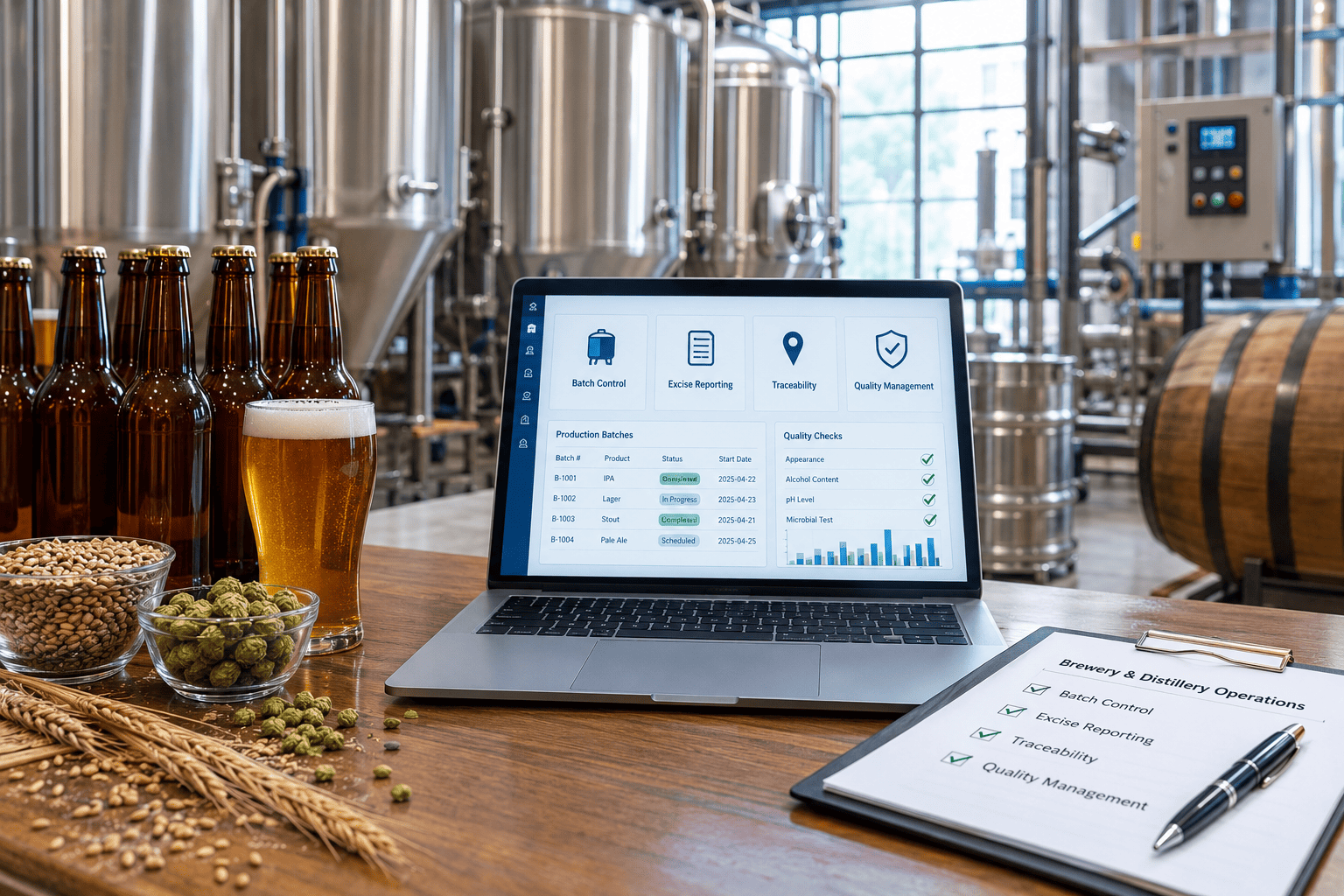
Most breweries and distilleries begin with whatever gets product out the door: a brewhouse scheduling tool, a spreadsheet for excise calculations, accounting software for the books, and a separate app for wholesale orders. That patchwork works when you are producing a few thousand barrels or running a single still. But as volumes climb, distribution expands, and new product lines arrive, the gaps between those systems start costing real money.
At some point every growing craft beverage producer faces the same question: should you keep extending brewery-specific software, or move to a full enterprise resource planning (ERP) system? This guide compares both approaches across the areas that matter most to brewers and distillers – batch production, traceability, excise compliance, distribution, costing, and quality – so you can make the decision with confidence.
The Fork in the Road Every Growing Producer Reaches
The trigger is rarely a single event. It is usually an accumulation of friction. Month-end close takes a week because production data has to be re-keyed into accounting. Excise reports depend on one person who knows how the spreadsheet works. A distributor asks for lot-level information on a pallet shipped three months ago, and it takes a full day to piece together. Sales cannot see real-time inventory of finished goods across the taproom, the warehouse, and consignment locations.
None of these problems is fatal on its own. Together, they signal that the business has outgrown a toolset designed for production alone and now needs a system designed to run the entire operation.
What Brewery-Specific Software Does Well
Purpose-built brewery and distillery applications earn their place for good reasons. They are typically fast to deploy, priced for small producers, and designed by people who understand fermentation. For a young operation, they offer genuine value:
• Brewhouse-friendly scheduling for tanks, fermenters, and brite tanks, often with visual cellar boards.
• Simple recipe management with ingredient lists and basic batch logging.
• Built-in excise worksheets that help small producers prepare federal reports.
• Low upfront cost and minimal IT overhead, which matters when cash is tight.
For a single-site brewery with a taproom and limited self-distribution, a point solution paired with entry-level accounting can be perfectly adequate.
Where Point Solutions Start to Strain
The limitations show up as complexity increases. Common pressure points include:
• Disconnected financials: production costs, inventory valuation, and the general ledger live in separate systems, so cost of goods sold is an estimate rather than a fact.
• Shallow traceability: tracking a finished case back to a specific malt lot, hop contract, or barrel often requires manual detective work.
• Limited distribution capability: multi-state wholesale, chain pricing, depletion tracking, and keg deposits stretch tools that were built for the brewhouse.
• Multi-entity and multi-site gaps: adding a second production facility, a contract brewing arrangement, or a separate spirits brand can mean running parallel systems.
• Quality data in silos: lab results, sensory panels, and deviations sit in notebooks or spreadsheets, disconnected from the batches they describe.
What a Full ERP Brings to Breweries and Distilleries
A modern cloud ERP such as Acumatica, configured for process manufacturing, connects production, inventory, sales, compliance, and finance in one system of record. Here is how that plays out in practice.
Recipe, Batch, and Process Control
ERP supports formula-based production with scalable recipes, yield tracking, and co-product and by-product handling – spent grain, for example, or heads and tails in distillation. Each batch consumes actual lots of raw materials, so variances between planned and actual usage are visible immediately rather than discovered at inventory count.
Lot Traceability from Grain to Glass
Every lot of malt, hops, yeast, botanicals, barrels, cans, and labels is recorded at receipt and linked to the batches that consume it. Forward and backward trace queries that once took hours return in seconds, which is essential for distributor requests, retailer audits, and recall readiness.
Excise and Regulatory Reporting
Because production, transfers in bond, removals, and losses are all recorded as transactions, the data required for TTB reports and state excise filings is generated from the same source as the financials. That reduces reliance on spreadsheets and the key-person risk that comes with them. Distillers benefit in particular from tracking proof gallons and barrel inventory through aging.
Distribution, Sales Channels, and Inventory
ERP manages wholesale orders, distributor pricing, keg deposits and returns, e-commerce, and taproom sales with a single view of available inventory. Warehouse functions support pick, pack, and ship by lot, and integrations connect to point-of-sale and EDI where needed.
True Cost per Barrel or Proof Gallon
With production and finance in one place, you can see actual landed cost per batch, per SKU, and per channel – including labor, overhead, packaging, and excise. That clarity drives better pricing, smarter product rationalization, and stronger conversations with lenders and investors.
Quality Management: Where the Decision Often Gets Made
For many producers, quality is the deciding factor. Consistency is the product. A single off-flavor batch that reaches the market can undo years of brand building, and retailers and distributors increasingly expect documented quality processes. Brewery-specific tools typically offer basic batch notes, but rarely a structured quality management system.
Acumatica paired with eWorkplace Apps QMS brings formal quality management directly into production and inventory workflows:
• Inspection plans define the tests required at each stage – incoming malt and hops, wort gravity, fermentation, packaging, and finished goods – so nothing is skipped.
• Automated inspection workflows trigger the right checks when material is received or a batch reaches a defined step, rather than relying on memory.
• Non-conformance workflows capture deviations such as dissolved oxygen out of spec, low fill levels, or failed sensory panels, and route them for review.
• Lot disposition management places suspect lots on hold, then releases, reworks, or rejects them with a full audit trail.
• CAPA tracking records root cause and corrective and preventive actions so recurring issues are resolved, not repeated.
• Digital COA generation produces certificates of analysis from recorded test results for distributors, contract customers, and export partners.
• Quality dashboards show first-pass yield, deviation trends, and supplier quality at a glance.
Because QMS runs inside the ERP, quality status directly controls inventory: a lot on hold cannot be picked or shipped. That connection is difficult to achieve when quality data lives outside the system that manages stock.
Side-by-Side Comparison
| Capability | Brewery-Specific Software | Full ERP (Acumatica + QMS) |
| Batch and recipe management | Strong for brewhouse basics | Formula-based with yield, co-products, and variance |
| Lot traceability | Partial; often manual | End-to-end, forward and backward |
| Excise reporting | Worksheets for small producers | Generated from transactional data |
| Financials and costing | Separate accounting system | Integrated GL with actual batch costing |
| Distribution and wholesale | Basic order entry | Multi-channel, pricing, deposits, EDI |
| Quality management | Batch notes | Inspection plans, NCR, CAPA, COA, lot holds |
| Multi-site and multi-entity | Limited | Native support |
| Upfront cost | Low | Higher, with lower long-term integration cost |
How to Decide: Five Questions to Ask
• How many systems touch a single batch from grain receipt to invoice? More than three usually means data is being re-keyed.
• Can you produce a full trace report in under an hour? If not, recall and audit risk is higher than it should be.
• Do you know your actual cost per barrel or proof gallon by SKU and channel, not an average?
• Are you planning growth through new states, a second facility, a spirits line, or contract production in the next three years?
• Is quality documented in a way a distributor or auditor would accept?
If you answered “no” or “yes, soon” to two or more, the business is likely ready for ERP. If your operation is small, stable, and local, a well-run point solution may still serve you well for now – and choosing a system that can grow later is the key decision.
Why Acumatica Fits Craft Beverage Producers
Acumatica is cloud-native, priced by resources consumed rather than per user, and flexible enough to model both brewing and distilling processes. That user-friendly licensing matters for producers where cellar staff, packaging crews, and taproom managers all need access. Its open architecture connects with point-of-sale, e-commerce, and EDI platforms, and its process manufacturing capabilities handle the realities of fermentation, aging, and blending.
The software is only part of the outcome, however. Configuration choices around units of measure, lot attributes, bonded inventory, and excise mapping determine whether the system delivers. That is where implementation experience in food and beverage makes the difference.
Making the Move with the Right Partner
As an Acumatica Gold Partner with more than 36 years of ERP implementation experience, Acuvera Tech helps breweries and distilleries move from disconnected tools to a unified platform without disrupting production. Our team maps your brewhouse, cellar, and distribution processes, configures Acumatica and eWorkplace Apps QMS to match, migrates historical data, and supports your team well beyond go-live.
Ready to See How ERP Fits Your Brewery or Distillery?
Talk with Acuvera Tech’s food and beverage ERP specialists about your production, compliance, and quality requirements. We will walk you through a tailored Acumatica demonstration built around craft beverage workflows.