
Feature Deep-Dive: The ERP Capabilities Chemical and Life Sciences Manufacturers Actually Need
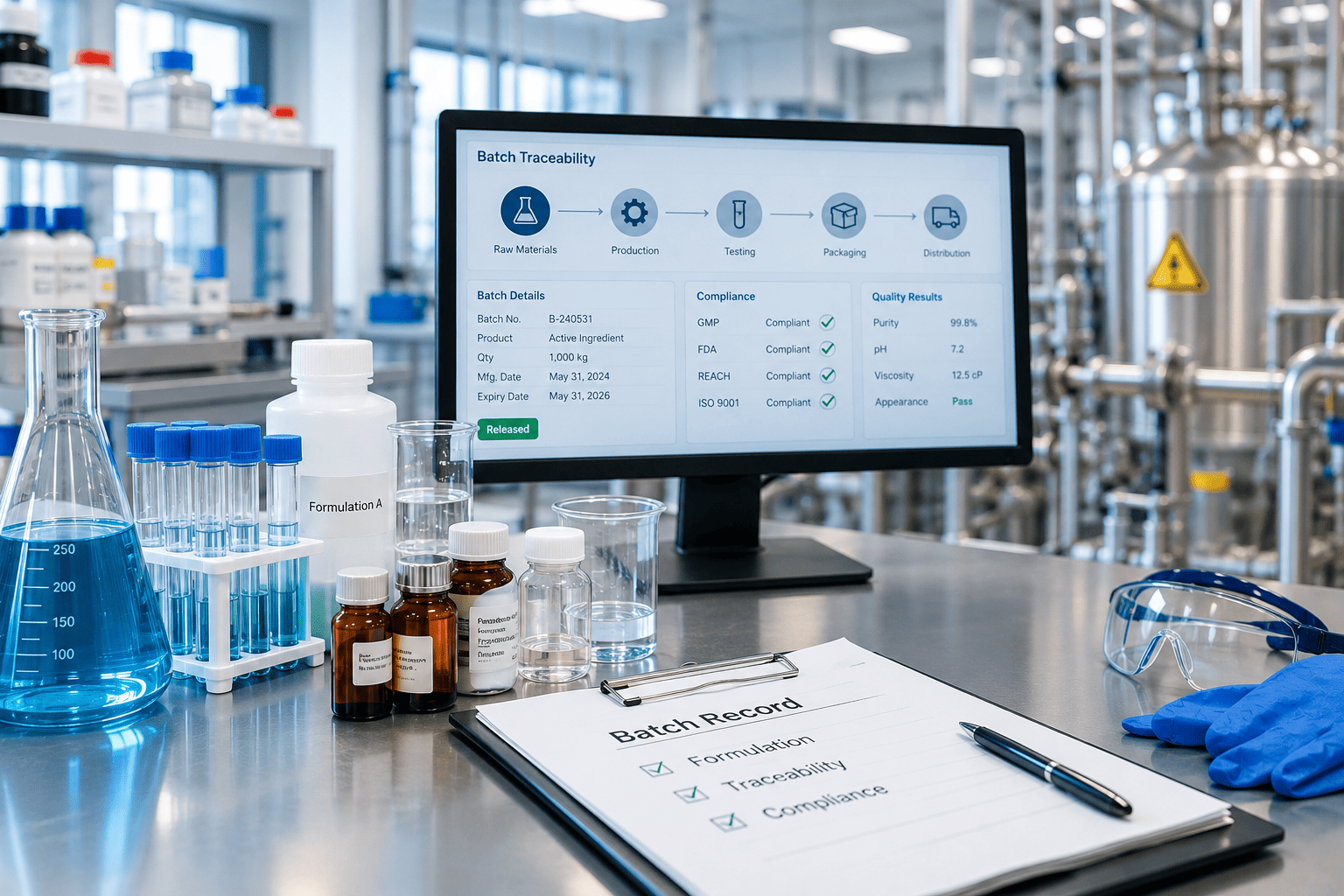
Chemical and life sciences manufacturers operate under a level of regulatory scrutiny and formulation complexity that most general-purpose ERP systems were never designed to handle. Every batch involves precise chemical proportions, hazardous material handling rules, and documentation requirements that regulators and customers alike expect to see on demand. When these processes are managed through spreadsheets, disconnected lab software, and manual data entry, the risk of a compliance gap or a costly production error rises with every batch produced. This blog examines the specific ERP features that matter most for chemical and life sciences manufacturers, and why they should be treated as core infrastructure rather than a future upgrade.
The sector spans a wide range of production environments, from specialty and fine chemicals to industrial coatings, adhesives, cleaning formulations, and life sciences inputs such as active pharmaceutical ingredients and lab reagents. What unites them is a shared dependency on formula precision, batch-level traceability, and documentation that can withstand regulatory and customer audits. A generic ERP system built for discrete manufacturing, where a bill of materials simply lists components rather than proportional formulas, forces chemical manufacturers into constant workarounds.
Growth compounds the problem. A chemical manufacturer that starts with a single product line and a single facility can, within a few years, be managing dozens of formulas, multiple production sites, and customers who each require different compliance documentation before they will accept a shipment. Systems that were adequate at a smaller scale become a genuine operational risk once that complexity sets in, particularly when the people who understand undocumented workarounds are the only ones who can keep production moving.
Why This Industry Needs Purpose-Built ERP Features
Three characteristics set chemical and life sciences manufacturing apart from other process industries. First, formulas are proportional and often sensitive to processing conditions such as temperature and mixing sequence, so scaling a batch is not a simple multiplication problem. Second, regulatory obligations span multiple frameworks simultaneously, including OSHA hazard communication, EPA reporting, REACH for products sold into the EU, and in some cases FDA oversight for life sciences applications. Third, hazardous material handling introduces safety and compliance requirements, such as Safety Data Sheet (SDS) management, that have no equivalent in most other manufacturing verticals.
Manufacturers that rely on manual processes for these functions typically discover the gap at the worst possible moment: during a customer audit, a regulatory inspection, or a recall investigation. Purpose-built ERP functionality closes that gap by keeping formulation, compliance, and traceability data inside a single connected system.
Core ERP Features for Chemical and Life Sciences Manufacturing
1. Formula and Recipe Management
Chemical manufacturing formulas are proportional by weight or volume, and small variances can affect product performance, stability, or safety.
• Percentage- and ratio-based formulation with automatic recalculation when batch size changes
• Multi-level formulas supporting intermediates, concentrates, and finished blends
• Formula version control with full audit history tied to regulatory filings and customer specifications
• Yield and byproduct tracking to reconcile theoretical versus actual output
2. Batch and Lot Traceability
Full genealogy tracking is essential both for regulatory compliance and for containing the cost of a quality issue if one arises.
• Forward and backward traceability from raw material lot through intermediate and finished product lots
• Genealogy reporting that identifies every customer shipment affected by a specific input lot within minutes
• Reactor- and vessel-level tracking for continuous or semi-continuous production processes
• Retain sample tracking tied to lot records for extended-shelf-life or regulated products
3. Hazardous Material and Regulatory Compliance
Chemical manufacturers manage compliance obligations that touch procurement, production, storage, and shipping simultaneously.
• Safety Data Sheet (SDS) management linked directly to raw material and finished product records
• Hazardous material classification and labeling data embedded in item master records
• Support for regulatory reporting frameworks, including OSHA, EPA, and REACH documentation
• DOT and IATA-compliant shipping documentation generated from the same system that manages inventory
4. Quality Control and Specification Management
Quality decisions for chemical products often hinge on lab test results that must be tied directly to the batch record, not stored separately.
• Configurable test plans for raw materials, in-process samples, and finished goods
• Specification-based pass/fail evaluation with automatic quality holds on out-of-spec results
• Certificate of Analysis (COA) generation tied to lot-specific test data
• Non-conformance and corrective action tracking integrated with supplier scorecards
5. Inventory and Warehouse Management for Hazardous Materials
Storage and handling requirements for chemical inventory go beyond standard warehouse logic.
• Segregation rules that prevent incompatible materials from being stored or picked together
• Container and drum-level tracking with tare weight and fill-level management
• Shelf-life and stability-based allocation to prevent shipment of degraded or expired material
• Multi-UOM support for materials tracked and sold in different units (weight, volume, containers)
6. Process Manufacturing and Production Scheduling
Batch, continuous, and semi-continuous production processes each place different demands on scheduling and shop floor execution.
• Production scheduling that accounts for reactor and equipment availability and cleanout time
• Recipe-driven work orders with in-process quality checkpoints built into the routing
• Real-time visibility into work-in-process inventory across multi-stage production
• Automatic backflushing of raw materials based on actual formula consumption
7. Cost Accounting and Regulatory Cost Tracking
Raw material costs in chemical manufacturing can be volatile, and compliance activities themselves carry a real cost that needs visibility.
• Real-time landed cost tracking that reflects raw material price and freight fluctuations
• Batch-level cost variance reporting comparing standard versus actual consumption
• Visibility into compliance-related costs, including testing, certification, and waste disposal
8. Multi-Site and Multi-Entity Operations
Chemical and life sciences manufacturers frequently operate multiple production facilities, distribution centers, or legal entities, sometimes across different regulatory jurisdictions.
• Consolidated financial reporting across multiple entities and currencies without manual reconciliation
• Site-specific regulatory configuration to reflect differing state, federal, or international requirements
• Centralized formula and specification management with site-level production visibility
• Inter-company transaction support for materials or intermediates transferred between facilities
Common Pitfalls When Systems Fall Short
Chemical and life sciences manufacturers running on generic ERP platforms or disconnected point solutions tend to run into a recurring set of problems.
• Recall or complaint investigations that take days because lot genealogy must be reconstructed manually across lab notebooks and spreadsheets
• SDS documents that fall out of date because they live outside the system that manages inventory and shipping
• Incompatible materials stored together due to warehouse systems that don’t enforce segregation rules
• Formula changes that aren’t reflected in the latest regulatory filing or customer specification, creating compliance exposure
• Manual cost roll-ups that don’t reflect real-time raw material price volatility, distorting margin visibility
Each of these risks is significantly reduced when formulation, compliance, quality, and inventory data are managed inside a single connected ERP platform rather than a patchwork of spreadsheets and standalone tools.
What to Look for in an ERP Evaluation
Chemical and life sciences manufacturers evaluating ERP platforms should prioritize a specific set of capabilities over generic feature checklists.
• Native percentage- and ratio-based formulation, not a workaround built on discrete manufacturing BOMs
• Built-in SDS and hazardous material data management, not a separate compliance database
• Warehouse management that enforces segregation and container-level tracking out of the box
• Reporting flexible enough to support OSHA, EPA, and REACH documentation without custom development
• An implementation partner with direct experience configuring ERP for chemical or life sciences production environments
Comparing Generic ERP vs. Purpose-Configured ERP for Chemical & Life Sciences
| Capability | Generic / Legacy ERP | Acumatica ERP (Configured for Chemical & Life Sciences) |
| Formula management | Discrete BOMs, manual proportion math | Native percentage/ratio-based formulation with auto-scaling |
| Batch traceability | Partial, reconstructed from lab records | Full forward/backward genealogy in real time |
| Hazardous material compliance | SDS managed outside the ERP | SDS and hazard data embedded in item records |
| Warehouse segregation | Manual, relies on staff knowledge | System-enforced incompatible material segregation |
| Quality holds | Manual, prone to human error | Automatic holds on out-of-spec lab results |
Choosing the Right ERP Partner
Selecting the right feature set on paper is only half the challenge. Implementation partners who understand chemical and life sciences production, from formula proportionality to hazardous material compliance, help ensure the system is configured around how your plant actually operates rather than forcing a generic manufacturing template onto a specialized process.
The configuration work is often what separates a system that quality, production, and compliance teams trust from one that generates constant workarounds. A partner who has implemented Acumatica specifically for chemical or life sciences manufacturers will already understand requirements such as reactor-level batch tracking, SDS-linked item records, and REACH-ready reporting structures, without needing those requirements explained from first principles. That experience tends to shorten implementation timelines and reduce the number of post-launch fixes needed to get the system production-ready.
It is equally important to evaluate how a partner supports the system after go-live. Regulations evolve, new markets bring new compliance obligations, and production processes change as facilities scale. An ERP configuration that cannot adapt to those shifts becomes a bottleneck rather than an asset. Look for a partner offering ongoing application managed services so the system continues to reflect your regulatory and operational reality as your business grows.
Ready to Modernize Your Chemical Manufacturing Operations?
Acuvera Tech helps chemical and life sciences manufacturers implement Acumatica ERP solutions built for formula management, batch traceability, and regulatory compliance. With 36+ years of ERP implementation experience, our team can help you evaluate the right fit for your production environment.