
Cloud vs. On-Premise ERP for Bottled Water & Water Treatment Beverage Manufacturers: Making the Right Choice
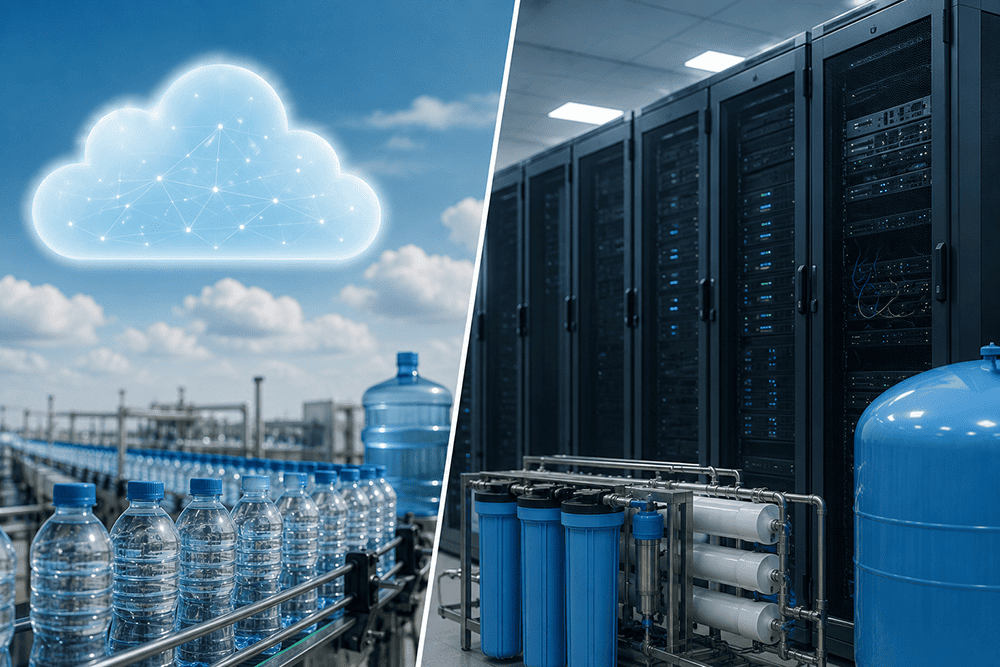
Bottled water and water treatment beverage manufacturers operate in one of the most tightly regulated, margin-sensitive corners of the F&B industry. Water sourcing, treatment, filtration, bottling, and distribution all have to be documented, traceable, and audit-ready – while production volumes swing with seasonal demand, weather, and retail promotions. When it’s time to choose or replace an ERP system, one of the biggest decisions producers face isn’t which modules to implement – it’s where the system should live: on-premise or in the cloud.
This decision affects far more than IT budgets. It shapes how quickly you can scale for a summer demand spike, how easily a co-packer or second facility gets real-time visibility into inventory, and how prepared you are when a state health department or the FDA comes calling. Here’s how the two deployment models actually compare for water and water-based beverage producers.
It’s also a decision that’s easy to get wrong by defaulting to familiarity. Many producers running on-premise ERP today inherited that model from a system implemented a decade or more ago, when cloud ERP wasn’t yet a mature option for regulated manufacturing. Revisiting the decision with current capabilities in mind – rather than assuming the original choice still fits – is worth the exercise, especially for producers planning growth, new facilities, or expanded co-packing relationships in the next few years.
Why This Decision Carries More Weight in Water & Beverage Production
Unlike many manufacturing sectors, water and water-based beverage producers deal with a specific combination of pressures: strict water quality and safety regulations, high-volume/low-margin economics, pronounced seasonality, and – increasingly – multi-site or co-packing arrangements that require shared visibility across locations. An ERP deployment model that can’t flex with seasonal volume or extend easily to a second site or a co-packing partner creates friction exactly when the business needs to move fastest.
What On-Premise ERP Offers
On-premise ERP keeps servers and infrastructure inside your own facility, under your own IT team’s direct control. For producers with strict data residency requirements, highly customized workflows, or an already-mature internal IT function, that control can be valuable – you decide when updates happen, how the environment is configured, and who has access, without depending on a third party’s infrastructure.
The trade-off is that this control comes with responsibility. Your team owns server maintenance, security patching, backup and disaster recovery planning, and the capital expense of hardware refreshes every few years. For a producer managing seasonal production swings, scaling that infrastructure up temporarily for a peak season – and back down afterward – is far harder to do with owned, on-site hardware.
What Cloud ERP Offers
Cloud ERP shifts infrastructure, maintenance, and security responsibility to the provider, giving your team access to the system from anywhere – a real advantage when production spans multiple bottling lines, warehouses, or co-packing partners. Instead of a large upfront capital investment, cloud ERP typically runs on a predictable subscription model, and capacity can scale up or down as seasonal demand shifts without a hardware purchase cycle.
For compliance-heavy producers, cloud ERP has an additional advantage: regulatory and feature updates are pushed centrally by the provider, so the system’s compliance-related functionality stays current without a manual IT project every time requirements change. Built-in redundancy and disaster recovery are also typically included, rather than something your team has to design and maintain independently.
Cloud vs. On-Premise: A Side-by-Side Comparison
|
Factor |
On-Premise ERP |
Cloud ERP |
|
Upfront Investment |
High capital outlay for servers, licenses, and IT infrastructure |
Low upfront cost; subscription-based operating expense |
|
IT Overhead |
Requires internal staff to maintain servers, backups, and security patching |
Infrastructure, updates, and security managed by the provider |
|
Scalability for Seasonal Demand |
Scaling up for peak bottling/production seasons requires new hardware purchases |
Scale usage up or down instantly as seasonal volume shifts |
|
Multi-Site & Co-Packer Visibility |
Difficult to extend real-time visibility to remote plants or co-packers |
Built-in remote access gives every site and partner the same real-time data |
|
Compliance & Traceability Updates |
Regulatory changes require manual updates and testing cycles |
Provider pushes updates centrally, keeping compliance features current |
|
Disaster Recovery |
Depends on your own backup and recovery infrastructure |
Built-in redundancy and recovery included in the service |
|
Total Cost of Ownership |
Higher over time once hardware refreshes and IT staffing are factored in |
Generally lower and more predictable across the system’s lifecycle |
Industry-Specific Factors That Should Influence Your Decision
Beyond the general cloud-versus-on-premise trade-offs, a few factors specific to water and water-based beverage production deserve extra weight in this decision:
• Batch and lot traceability from source water through treatment, bottling, and distribution
• Shelf-life and expiration tracking across SKUs, package sizes, and private-label runs
• Water quality test result documentation tied to each production batch
• Packaging SKU complexity – multiple bottle sizes, case configurations, and private-label variants
• Seasonal and promotional demand spikes that require rapid scaling of both production and system capacity
• Real-time visibility across multiple facilities or co-packing partners
Producers with a single facility, stable volume, and an established internal IT team may find on-premise ERP perfectly workable. Producers managing multiple sites, co-packers, seasonal swings, or growth plans that outpace their current IT footprint tend to find cloud ERP the more sustainable long-term fit.
Addressing Common Concerns About Moving to the Cloud
Producers who have run on-premise systems for years often raise the same set of concerns when cloud ERP comes up, and each is worth addressing directly. Data security is usually the first: reputable cloud ERP providers invest in security infrastructure – encryption, access controls, monitoring – that few mid-sized manufacturers can match with an internally managed on-premise environment. Internet dependency is the second: modern cloud ERP platforms are built with reliability and offline resilience in mind, and for most producers the risk of an internet outage is smaller than the risk of an aging on-site server failing without a comparable recovery plan. Cost predictability is the third: while a subscription model represents an ongoing expense rather than a one-time purchase, it also removes the unpredictable capital spikes that come with hardware refreshes, emergency repairs, and the eventual replacement of aging on-premise infrastructure.
None of this means cloud is automatically the right answer for every producer. A facility with a single site, a stable production footprint, and an IT team that already manages the infrastructure well may see limited benefit from migrating. The point isn’t that cloud wins by default – it’s that the calculation should be run deliberately, against your actual operational profile, rather than assumed.
What a Phased Migration Can Look Like
For producers currently on an aging on-premise system, the move to cloud ERP doesn’t have to happen all at once. A phased approach – starting with a single facility or a specific process area, validating performance and user adoption, then expanding to additional sites or co-packing partners – reduces risk and gives your team time to adjust workflows without disrupting production. This is particularly useful heading into a compliance-heavy environment, where getting quality and traceability workflows right in a controlled rollout matters more than speed.
Strengthening Quality Control with eWorkplace Apps Quality Management Suite
Whatever infrastructure model you choose, water and water-based beverage producers face a quality management burden that generic ERP functionality doesn’t fully address – frequent water quality testing, batch-level documentation, and audit-ready records tied to health and safety regulations. This is where the eWorkplace Apps Quality Management Suite, built to extend ERP systems like Acumatica, becomes a critical layer for F&B and beverage manufacturers.
The suite is designed to support the specific quality demands of water and beverage production, including:
• Digitized water quality and lab test result capture, tied directly to batch and lot records
• Automated non-conformance and CAPA (Corrective and Preventive Action) workflows
• Configurable quality checkpoints throughout the production and bottling process
• Audit-ready documentation aligned to FDA and state health department requirements
• Real-time visibility into quality holds, so non-conforming batches can’t move downstream by accident
Whether your ERP runs on-premise or in the cloud, integrating a dedicated quality management layer reduces the manual, spreadsheet-driven tracking that creates compliance risk – and gives your quality team a single source of truth they can stand behind during an inspection or a recall investigation.
Making the Right Choice for Your Operation
There’s no single right answer for every water or beverage producer – the right deployment model depends on your current infrastructure, growth trajectory, compliance exposure, and how many sites or partners need real-time visibility into the same data. What matters is evaluating the decision against your actual production and compliance realities, rather than defaulting to whatever model your business has always used. As regulatory scrutiny on water quality and food safety continues to increase, and as production networks grow more distributed through co-packing and multi-site operations, the ERP foundation you choose today will shape how easily your business can adapt tomorrow.
Not Sure Which ERP Deployment Fits Your Operation?
Acuvera Tech helps bottled water and water-based beverage manufacturers evaluate cloud and on-premise Acumatica ERP options against their real production, compliance, and growth needs. Schedule a consultation and get a clear, no-obligation recommendation for your operation.