
Handling Hazardous Materials Across Units of Measure: What Chemical and Life Sciences Manufacturers Need From ERP
Two Kinds of Complexity, One Inventory Record
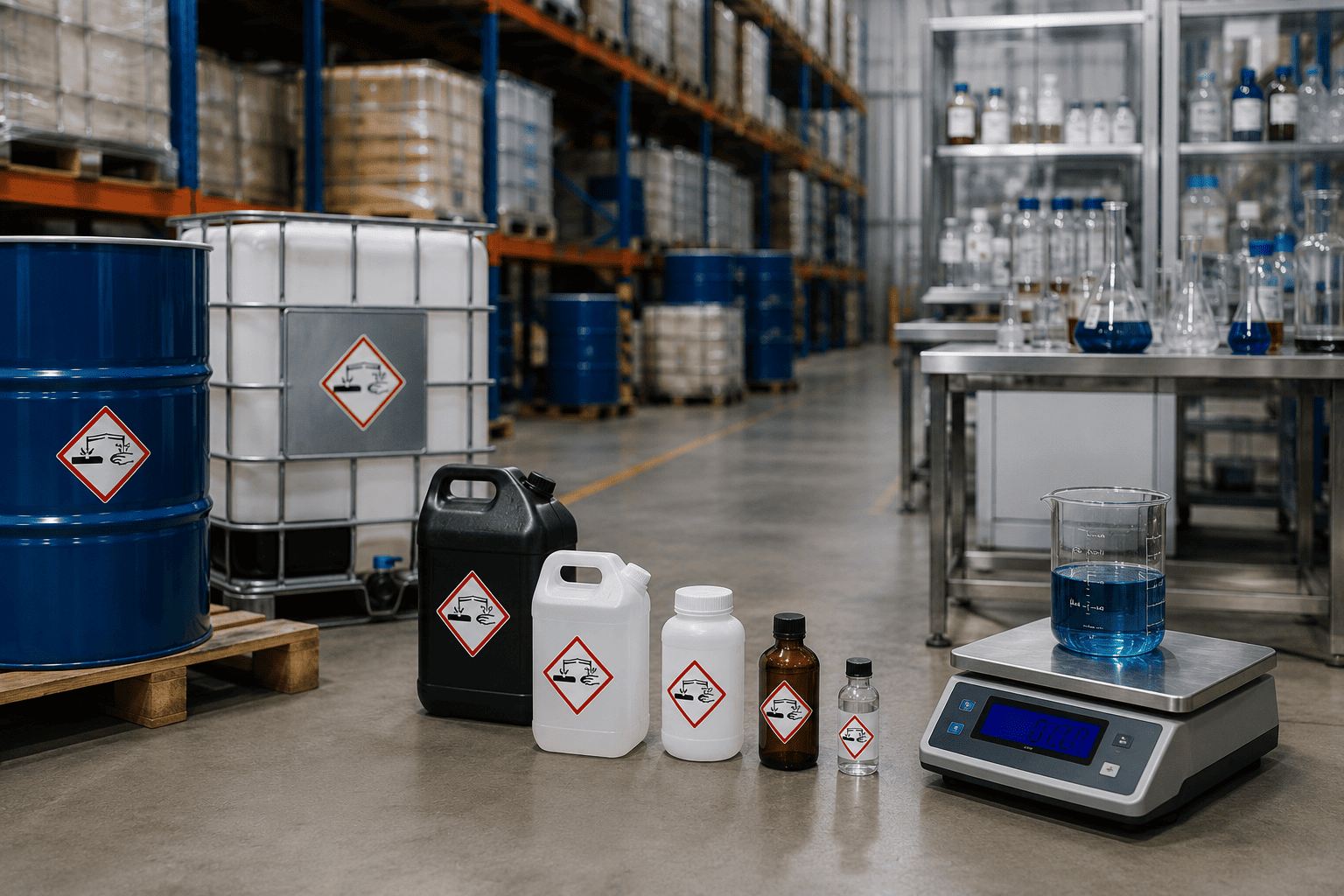
Chemical and life sciences manufacturers manage a form of inventory complexity that few other industries face in combination. Raw materials and finished goods carry hazard classifications – flammable, corrosive, toxic, oxidizing – that dictate how they must be stored, handled, and shipped. At the same time, the same materials move through purchasing, production, and distribution in multiple units of measure: drums, totes, gallons, liters, kilograms, pounds, each with its own conversion logic, and for many chemical products, that conversion depends on density, which varies by formulation and even by batch.
These two layers of complexity – hazard classification and unit-of-measure conversion – aren’t separate problems. They intersect constantly. A conversion error on a hazardous product doesn’t just create a costing discrepancy; it can mean the wrong quantity gets referenced on a shipping document that also carries hazmat classification data, with real regulatory and safety consequences.
Where This Complexity Creates Risk
Talk to operations and EHS teams at chemical manufacturers, and a consistent set of risk points comes up:
- Manual conversion errors – converting between weight and volume for chemicals with variable density is done by hand in many operations, and a single incorrect conversion factor can cascade through costing, inventory, and shipping records.
- Disconnected hazard classification data – UN numbers, packing groups, and hazard classes are frequently maintained in a separate compliance spreadsheet rather than tied directly to the inventory item, so the data doesn’t automatically flow into transactions.
- SDS and documentation gaps – safety data sheets often live in a shared drive rather than attached to the item record, making it harder to confirm the right version is referenced at receiving or shipping.
- Shipping documentation errors – bills of lading and hazmat shipping papers assembled manually risk missing or mismatched classification data, which can trigger carrier rejections or compliance violations.
- Storage and segregation gaps – compatibility rules for storing incompatible hazard classes apart from each other frequently rely on posted charts and staff training rather than system-enforced putaway logic.
Why Generic ERP Systems Don’t Close the Gap
Many chemical manufacturers run on ERP systems that were designed for general manufacturing or distribution, with hazardous material tracking and unit-of-measure conversion added as an afterthought rather than built into the core data model. In these systems, an item’s hazard classification might live in a custom field or a linked document, disconnected from the transactions that actually move that item through the business.
The practical effect is that hazard and conversion data have to be manually cross-referenced every time they matter – at receiving, at putaway, at order fulfillment, at shipping. Each of those manual touchpoints is an opportunity for the wrong classification, the wrong conversion factor, or an outdated SDS reference to slip through. In an industry where the cost of getting it wrong ranges from a shipping delay to a serious safety incident, that level of manual dependency is a real and ongoing risk, not just an efficiency issue.
What Native Hazmat and Multi-UOM Handling Looks Like in an ERP
An ERP built to handle both hazardous material classification and multi-UOM conversion natively, such as Acumatica, ties this data directly to the item master rather than maintaining it in parallel systems. In practice, that means:
- Hazard classification, UN number, and packing group stored directly on the item record, so the data is present on every transaction that touches that item.
- Density-based conversion factors that accurately translate between weight and volume units for each specific product, rather than relying on a generic assumed conversion.
- System-enforced storage and segregation rules that flag or block putaway assignments that would place incompatible hazard classes too close together.
- Safety data sheets attached at the item level, accessible to receiving and shipping staff at the exact point where they need to reference them.
- Shipping documents that auto-populate hazmat classification data directly from the item master, reducing the risk of a manual transcription error making it onto a bill of lading.
Manual Hazmat & UOM Handling vs. Unified ERP-Native Handling
| Operational Area | Manual, Disconnected Hazmat & UOM Handling | Unified ERP-Native Handling |
| UOM Conversion Accuracy | Weight-to-volume conversions calculated manually per product, prone to error | Density-based conversion factors defined once per item and applied automatically |
| Hazmat Documentation | Hazard class, UN number, and packing group tracked separately from inventory records | Hazard classification data lives on the item master and travels with every transaction |
| Storage Compliance | Segregation and compatibility rules rely on staff memory and posted charts | System-enforced putaway rules flag or block incompatible storage assignments |
| Shipping Accuracy | Bills of lading and hazmat shipping papers assembled manually, risking omissions | Shipping documents auto-populate hazmat data directly from the item record |
| Audit Readiness | SDS and compliance records stored separately, making audits slow to assemble | SDS and compliance data linked to the item and accessible at every transaction point |
Signs Your Operation Has Outgrown Manual Hazmat Management
Certain patterns tend to indicate that a chemical or life sciences manufacturer’s current approach to hazmat and UOM handling has fallen behind its actual operational complexity:
- Shipping documentation errors or carrier rejections related to hazmat classification happen with any regularity.
- EHS staff spend significant time manually cross-referencing inventory records against a separate compliance spreadsheet to confirm accurate hazard data.
- New product introductions require rebuilding conversion and classification logic manually rather than reusing existing structured item data.
- Audits require assembling SDS documentation, classification records, and inventory transactions from multiple disconnected sources.
- Storage assignment relies primarily on staff training and posted charts rather than system-enforced rules.
Each of these signals the same underlying gap: hazard and unit-of-measure data exist somewhere in the business, but not as structured, connected information the system can act on automatically.
Cross-Functional Impact Beyond Compliance
While hazmat and UOM handling are often framed primarily as a compliance and safety concern, the operational benefits extend well beyond EHS. Sales and customer service teams gain the ability to quote accurately on products where weight-to-volume conversion affects pricing, without waiting on a manual calculation. Finance gains cleaner costing data, since conversion errors that used to distort inventory valuation are eliminated at the source. Warehouse teams gain clearer, system-enforced guidance instead of relying on posted charts and tribal knowledge to make correct storage decisions under time pressure.
Framing this as a cross-functional data accuracy initiative, rather than solely a compliance project, tends to make the business case easier to build – the same underlying fix addresses friction points that sales, finance, warehouse, and EHS teams have each been managing separately, often without realizing how closely connected the root cause actually is.
What an Implementation Actually Involves
Consolidating hazmat classification and multi-UOM conversion into a unified ERP is a structured project, and one that benefits significantly from an implementation partner experienced in chemical and life sciences operations rather than a generic manufacturing rollout.
A typical implementation starts by cataloging the full item master, including hazard classifications, UN numbers, packing groups, density-based conversion factors, and associated SDS documentation – much of which may currently exist in separate systems or spreadsheets. That data is then structured into the ERP’s item records, with storage compatibility rules configured to match the facility’s actual segregation requirements.
Shipping document templates are configured to pull hazmat data automatically from the item master, and a validation period running new transactions alongside existing manual documentation allows compliance and operations teams to confirm accuracy before fully retiring the old process.
A Moving Regulatory Target
Hazardous material regulations are not static. DOT, OSHA, and EPA requirements are periodically updated, and chemical manufacturers operating internationally also have to account for varying classification and documentation standards across jurisdictions. A system where hazard classification data is scattered across spreadsheets and individual employees’ knowledge makes it far harder to confirm that every item record reflects the current regulatory requirement, let alone to update records efficiently when a requirement changes.
Centralizing hazard classification within the ERP’s item master doesn’t just improve day-to-day accuracy – it also creates a single place to manage regulatory updates, rather than requiring someone to track down and correct the same information across multiple disconnected systems every time a rule changes.
What This Means for the Bottom Line
Bringing hazardous material classification and multi-UOM conversion under one ERP-native system changes the risk and cost profile of chemical and life sciences operations:
- Reduced compliance risk and exposure to fines from inaccurate or incomplete hazmat documentation.
- Fewer shipping errors and carrier holds caused by missing or mismatched classification data.
- Safer storage through system-enforced segregation rules rather than reliance on staff memory.
- Faster quote-to-ship cycles, since conversion and documentation no longer require manual cross-referencing.
- Audit-ready documentation that links classification, SDS, and transaction history in one accessible place.
For chemical and life sciences manufacturers, unifying hazardous material and unit-of-measure management inside one ERP platform addresses two of the industry’s most persistent risk points at the same time, rather than treating them as separate initiatives.
Manage Hazardous Materials With Confidence, Not Workarounds
Acuvera Tech helps chemical and life sciences manufacturers implement Acumatica ERP with native hazardous material and multi-UOM handling, so compliance and inventory accuracy finally live in one system. Talk to our team to see how unified hazmat management fits your operation.