
Coffee & Tea ERP: Solving the Operational Pain Points That Hold Roasters and Blenders Back
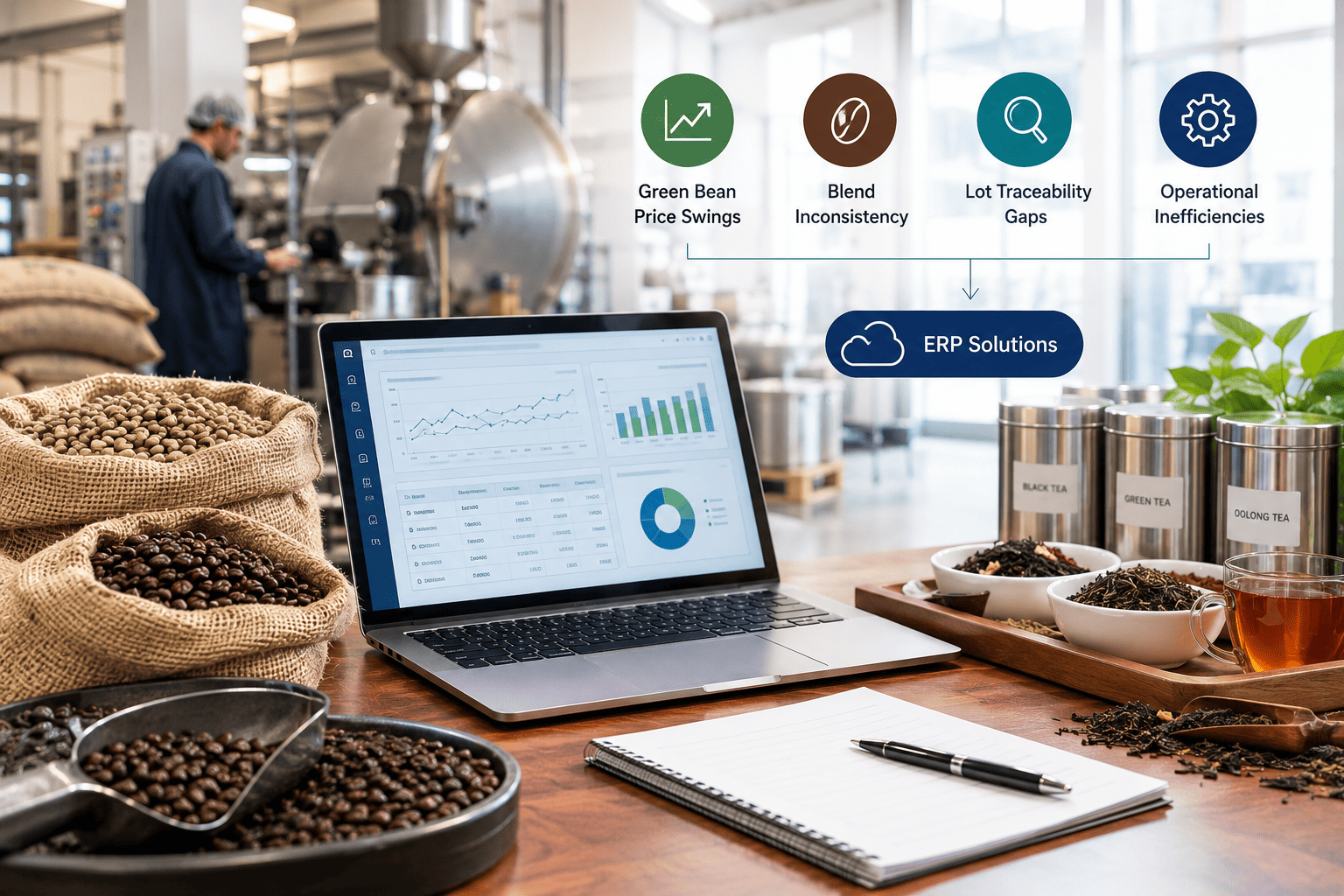
Coffee and tea are among the most traded agricultural commodities in the world, and among the most demanding to manage well. Roasters and blenders juggle volatile green-bean and leaf prices, origin-specific quality, moisture and weight loss during processing, and customers who expect every cup to taste exactly like the last one. At the same time, the business is expanding in every direction: wholesale accounts, private label, subscriptions, e-commerce, cafés, and retail shelves.
Many coffee and tea companies still run this complexity on a mix of spreadsheets, roasting software, entry-level accounting, and an online store platform. The result is a set of recurring pain points that quietly erode margin and slow growth. This article examines the most common ones and how a modern ERP system addresses each.
Pain Point 1: Green Coffee and Leaf Costs You Cannot Pin Down
Green coffee is bought by contract, often months ahead of arrival, priced against a fluctuating market plus differentials, freight, import costs, and warehousing fees. Tea leaf purchasing carries similar complexity across estates, auctions, and grades. When those costs are tracked in spreadsheets, the true landed cost of each lot is rarely known with confidence.
The consequence is pricing built on assumptions. Wholesale price lists lag behind cost movements, and margin by product, customer, or channel becomes an estimate. Over a season of market swings, that gap can be substantial.
How ERP helps: ERP records each purchase contract, allocates freight, duties, and storage to specific lots as landed cost, and carries that actual cost through roasting or blending into finished goods. Finance and sales see real margin by SKU and customer, and price updates can be driven by data rather than instinct.
Pain Point 2: Weight Loss and Yield That Never Reconcile
Roasting removes moisture, and a green coffee loses a meaningful share of its weight depending on origin, density, and roast profile. Tea processing and blending introduce their own losses through sifting, dust, and handling. If production records do not capture actual input and output weights, inventory drifts away from reality and cost of goods sold becomes inaccurate.
Many roasters discover the problem only at physical count, when the numbers simply do not add up and nobody can explain why.
How ERP helps: Production orders in ERP record actual green input and roasted output for every batch, calculating yield and variance automatically. Expected loss factors can be set by profile, so unusual losses are flagged immediately. Inventory stays accurate, and cost reflects what really happened in the roaster.
Pain Point 3: Blend Consistency Across Changing Crops
A signature blend is a promise to the customer. But crops change every harvest, lots vary in flavor and moisture, and a component origin may become unavailable mid-year. Master roasters and tea blenders adjust recipes to maintain the flavor profile, yet those adjustments often live in notebooks or individual memory.
When recipe history is undocumented, it is difficult to reproduce a successful blend, explain a customer complaint, or train new production staff.
How ERP helps: ERP manages versioned formulas with effective dates, allowing approved substitutions and recording exactly which lots went into each batch. When a blend is adjusted, the change is controlled and traceable. Planning tools show upcoming component requirements so purchasing can secure replacement origins before supply runs short.
Pain Point 4: Traceability Gaps from Farm to Cup
Origin storytelling is central to specialty coffee and premium tea, and certifications such as organic, Fair Trade, and Rainforest Alliance depend on proving where product came from. Retailers and food-safety programs also expect fast trace-back if a problem arises. With disconnected systems, tracing a retail bag back to its green lots, or a green lot forward to every customer who received it, can take days.
How ERP helps: Lot tracking in ERP links each contract, container, and warehouse lot through roasting, blending, and packaging to the final shipment. Certification attributes travel with the lot, so certified and conventional inventory are never confused. Forward and backward trace reports take seconds rather than days.
Pain Point 5: Freshness, Shelf Life, and Inventory Aging
Roasted coffee is at its best within weeks, and even well-packaged tea has a defined shelf life. Overproduction leads to stale stock and write-offs; underproduction leads to stockouts on popular items. Without clear visibility of roast dates and expiry by lot, warehouse teams cannot reliably ship oldest-first, and wholesale customers may receive product closer to its best-by date than they expect.
How ERP helps: ERP tracks roast and expiry dates for every lot, enforces first-expired, first-out picking, and alerts teams to aging inventory. Demand planning based on sales history, subscriptions, and wholesale orders helps schedule roasts to match demand, reducing both waste and stockouts.
Pain Point 6: Too Many Sales Channels, Not Enough Visibility
A growing roaster may sell through wholesale accounts, cafés, grocery chains, its own e-commerce site, third-party marketplaces, and subscription programs, each with different pricing, packaging, and fulfillment requirements. When every channel runs on its own system, inventory is double-counted or oversold, and nobody has a single view of performance.
How ERP helps: A cloud ERP such as Acumatica serves as the central system for orders and inventory, connecting to e-commerce platforms, point-of-sale, and EDI for retail partners. Inventory availability is shared across channels in real time, and reporting shows profitability by channel, customer, and product line.
Pain Point 7: Quality Control That Lives on Paper
Quality in coffee and tea is measured constantly: moisture and defect counts on green arrivals, cupping scores, roast color readings, foreign-material checks, and packaging seal integrity. In many operations, these results are recorded on paper forms or spreadsheets disconnected from inventory. A lot that fails cupping might still be pulled into production because nothing in the system says otherwise.
Acumatica combined with eWorkplace Apps QMS brings structured quality management into everyday workflows:
• Inspection plans define the checks required for green coffee and tea arrivals, in-process roasting or blending, and finished packaging.
• Automated inspection workflows trigger tests when a lot is received or a batch reaches a defined stage, so checks are never skipped.
• Non-conformance workflows capture out-of-spec moisture, defect counts, cupping failures, or seal issues and route them for review and decision.
• Lot disposition management places questionable lots on hold until they are released, reblended, returned to the supplier, or rejected – with a full audit trail.
• CAPA tracking documents root causes and corrective and preventive actions, from supplier issues to equipment calibration.
• Digital COA generation produces certificates of analysis for private-label customers, retailers, and export partners directly from recorded results.
• Quality dashboards surface supplier performance, defect trends, and first-pass quality rates for continuous improvement.
Because quality status is connected to inventory, a lot on hold cannot be consumed in production or shipped to a customer. Quality becomes a control, not just a record.
The Cost of Leaving These Pain Points Unsolved
|
Pain Point |
Business Impact |
ERP Capability |
|
Unclear landed cost |
Margin erosion, lagging prices |
Contract and landed-cost tracking by lot |
|
Unreconciled roast loss |
Inaccurate inventory and COGS |
Actual yield and variance per batch |
|
Blend inconsistency |
Customer complaints, lost accounts |
Versioned formulas and controlled substitutions |
|
Traceability gaps |
Certification and recall risk |
End-to-end lot tracking with attributes |
|
Stale inventory |
Write-offs and stockouts |
Roast and expiry dating, FEFO picking |
|
Channel silos |
Overselling, no channel profitability |
Unified orders and inventory across channels |
|
Paper-based quality |
Defective product reaching customers |
Integrated QMS with lot holds and CAPA |
Why Acumatica Fits Coffee and Tea Companies
Acumatica is a cloud-native ERP built for growing businesses, with process manufacturing, lot and serial tracking, landed cost, and multi-channel commerce in a single platform. Its resource-based licensing means roasters, warehouse staff, sales teams, and café managers can all have access without per-user costs climbing as the team grows. Open integration makes it straightforward to connect roasting equipment data, e-commerce storefronts, and retail EDI.
Implementation choices – units of measure for green versus roasted product, lot attributes for origin and certification, loss factors, and quality checkpoints – determine how well the system fits. Getting them right requires a partner who understands food and beverage operations.
Partner with Acuvera Tech
With more than 36 years of ERP implementation experience and Acumatica Gold Partner status, Acuvera Tech helps coffee roasters and tea blenders replace disconnected tools with one integrated platform. We map your sourcing, roasting or blending, packaging, and distribution processes; configure Acumatica and eWorkplace Apps QMS around them; and support your team long after go-live.
Brew Better Operations with Acumatica
Talk with Acuvera Tech’s food and beverage ERP specialists about the challenges in your roasting or blending operation. We will show you how Acumatica and integrated quality management can bring cost, traceability, and consistency under control.