
Shelf-Life & Spoilage Risk in Plant-Based Dairy Alternatives: Protecting Margin When the Clock Is Working Against You
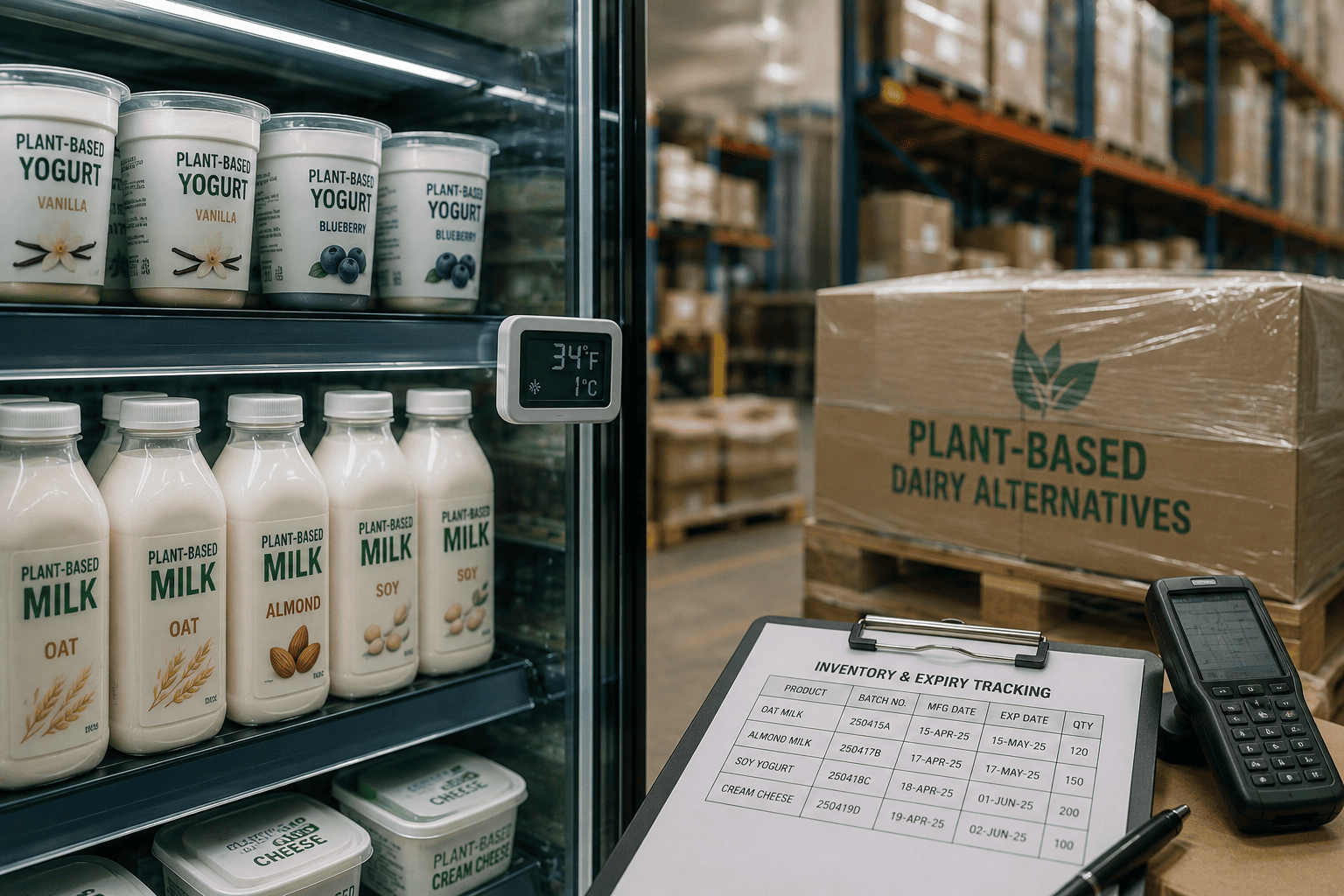
Plant-based dairy alternatives – oat, almond, soy, pea, and coconut-based milks, creamers, and yogurts – are among the fastest-growing categories in the beverage and dairy case. But growth has exposed a problem that doesn’t get nearly as much attention as new product launches: shelf life. Many plant-based dairy alternatives carry tighter, more variable shelf-life windows than the conventional dairy products they sit next to, and that reality puts direct pressure on inventory planning, distribution scheduling, and ultimately, margin.
For manufacturers running lean inventory systems or managing shelf life with spreadsheets and manual FEFO (first-expired-first-out) tracking, the result is a slow, steady leak of profitability – write-offs, retailer chargebacks, and rush shipments that all trace back to the same root cause: not enough real-time visibility into how much time a batch actually has left.
Why Shelf Life Hits Plant-Based Products Harder
Conventional dairy benefits from decades of established processing, packaging, and distribution practices tuned to its shelf-life profile. Plant-based alternatives are newer, more varied in formulation, and often more sensitive to temperature fluctuations and handling delays. A batch of oat milk or a pea-protein yogurt doesn’t necessarily follow the same aging curve as the conventional product it’s positioned next to on the shelf – which means applying legacy shelf-life assumptions to a plant-based line can quietly overstate how much runway a batch actually has.
Add in the SKU proliferation that comes with rapid category growth – multiple flavors, package sizes, and private-label variants, often produced on shared lines – and the result is a shelf-life tracking problem that outgrows what a spreadsheet or a manual expiration log can reliably manage.
Where the Pressure Shows Up
|
Pressure Point |
Why It Happens |
What It Costs You |
|
Short Code Dates |
Fixed dating windows leave little room for delays; product ages out before it clears distribution |
Higher write-offs, more markdowns, tighter delivery windows |
|
Batch & Lot Complexity |
Multiple SKUs, flavors, and package formats each carry different shelf-life clocks |
Manual tracking errors; FEFO (first-expired-first-out) picking mistakes |
|
Cold Chain Sensitivity |
Plant-based dairy alternatives are often more temperature-sensitive than conventional dairy |
Spoilage risk multiplies with every extra handoff or delay |
|
Retail Chargebacks |
Retailers penalize short-dated or expired product on delivery |
Direct margin hit plus damaged retailer relationships |
|
Demand Forecasting Gaps |
New product lines have limited sales history to forecast against |
Overproduction sits too long; underproduction causes stockouts |
The Hidden Cost of Manual Shelf-Life Tracking
Most manufacturers don’t lack the discipline to manage shelf life – they lack the system to do it efficiently at scale. When expiration tracking lives in spreadsheets, disconnected from the ERP system that’s actually managing inventory and shipping, gaps are inevitable. A warehouse team picking against a printed report rather than real-time data has no way to know if a batch’s status changed an hour ago. A planner forecasting demand without visibility into current shelf-life exposure can’t tell which SKUs are at real risk of aging out before they sell through.
The financial impact compounds quickly. Every case written off as expired is a case that already consumed ingredients, labor, and production capacity – meaning the loss isn’t just the retail value, it’s the fully loaded cost of production with nothing recovered. Retailer chargebacks for short-dated deliveries carry a similar dynamic: the product cost is sunk, and the chargeback adds an additional penalty on top of it.
There’s a compounding effect that’s easy to underestimate too: once write-offs and chargebacks start eating into margin, the instinct is often to build in more safety stock or pad delivery timelines – which increases the average age of inventory sitting in the system and makes the underlying shelf-life problem worse, not better. Breaking that cycle requires visibility, not more buffer.
Building Shelf-Life Visibility Into Your ERP System
The fix isn’t more manual tracking – it’s connecting shelf-life data to the same system that’s already managing inventory, production, and distribution. When expiration dates are tracked at the batch and lot level inside the ERP itself, a few things become possible that a spreadsheet can’t deliver:
• Automated FEFO enforcement during picking, so the oldest eligible inventory always ships first
• Real-time alerts when a batch crosses a risk threshold, giving sales and distribution teams time to act
• Accurate available-to-promise calculations that account for remaining shelf life, not just raw unit counts
• Demand forecasting that incorporates shelf-life exposure alongside sales velocity
• Full batch and lot traceability from production through delivery, supporting both quality and recall readiness
This shifts shelf-life management from a reactive, end-of-life scramble to a proactive planning input – one that shapes production scheduling and distribution routing well before a batch is ever at risk.
Rethinking Production Scheduling Around Shelf Life
Shelf-life visibility should feed backward into production, not just forward into distribution. When planners can see which SKUs are running tight on remaining shelf life across the distribution network, that information becomes a direct input into the production schedule – prioritizing runs that replenish at-risk inventory before it’s actually depleted, rather than production simply following a static calendar disconnected from real sell-through and expiration data. For co-packed or private-label lines, this matters even more, since a single shared production line may be serving several customer specs and shelf-life requirements at once, and a scheduling miss on one line can ripple across multiple customer commitments.
This is also where demand forecasting and shelf-life data need to work together rather than in separate systems. A new plant-based SKU with limited sales history is already hard to forecast; layering in a short, sometimes-variable shelf-life window without integrated data makes overproduction and underproduction both more likely – and both carry a cost, whether it’s write-offs on one end or stockouts and lost distribution slots on the other.
Distribution Scheduling Under Shelf-Life Pressure
Shelf life doesn’t just affect the warehouse – it shapes distribution strategy. Routes, delivery frequency, and even customer prioritization often need to account for how much runway a batch has left. Manufacturers with real-time shelf-life visibility can make smarter calls about which customers or regions get which batches, routing shorter-dated product to nearby, high-velocity accounts while reserving longer-dated inventory for customers farther down the distribution chain. Without that visibility, those decisions default to whatever’s easiest logistically – not what actually protects margin.
Retail partners add another layer of pressure. Many large grocery and natural-foods retailers enforce strict minimum-shelf-life requirements on receipt – often demanding 60%, 70%, or even 80% of remaining shelf life at time of delivery. Falling short of that threshold isn’t just a missed opportunity; it typically triggers an outright rejection or a chargeback, and repeated violations can jeopardize the retailer relationship entirely. Manufacturers who can see shelf-life exposure by batch and by destination in real time are far better positioned to route product proactively and avoid these penalties, rather than discovering the problem at the receiving dock.
Managing Quality and Freshness with eWorkplace Apps Quality Management Suite
Shelf-life risk isn’t just an inventory problem – it’s a quality problem that starts on the production floor. The eWorkplace Apps Quality Management Suite, built to extend ERP platforms like Acumatica, gives plant-based dairy alternative producers the quality infrastructure to catch problems before short-dated product ever reaches a warehouse or a retailer’s dock.
For manufacturers managing tight shelf-life windows, the suite supports:
• Batch and lot-level quality checkpoints tied to production dates, not just finished-goods inspection
• Automated inspection workflows that flag deviations before product moves downstream
• Lot disposition management, so questionable batches are held rather than shipped on schedule by default
• CAPA (Corrective and Preventive Action) workflows that trace recurring quality issues back to root cause
• Real-time visibility connecting quality status directly to inventory and shipping decisions
When quality data and inventory data live in the same system rather than separate spreadsheets, FEFO picking, hold decisions, and customer commitments can all be driven by the same accurate, real-time information – reducing the number of short-dated units that make it out the door in the first place.
Turning Shelf Life From a Liability Into a Planning Advantage
Tight shelf-life windows aren’t going away for plant-based dairy alternatives – if anything, as the category matures and competition increases, the margin pressure around spoilage and write-offs will only grow. The manufacturers who get ahead of it are the ones treating shelf life as a data problem to be solved at the system level, not a warehouse-floor problem to be managed with clipboards and printed reports. Getting production, quality, and inventory data into one connected system is what makes that shift possible – turning a source of chronic margin leakage into a planning advantage instead.
Losing Margin to Short-Dated Product?
Acuvera Tech helps plant-based dairy alternative manufacturers connect production, quality, and inventory in one system – so shelf-life risk gets managed proactively instead of discovered at the dock. Schedule a consultation to see how it works for your operation.