
Feature Deep-Dive: The ERP Capabilities Nutraceuticals and Functional Food Manufacturers Actually Need
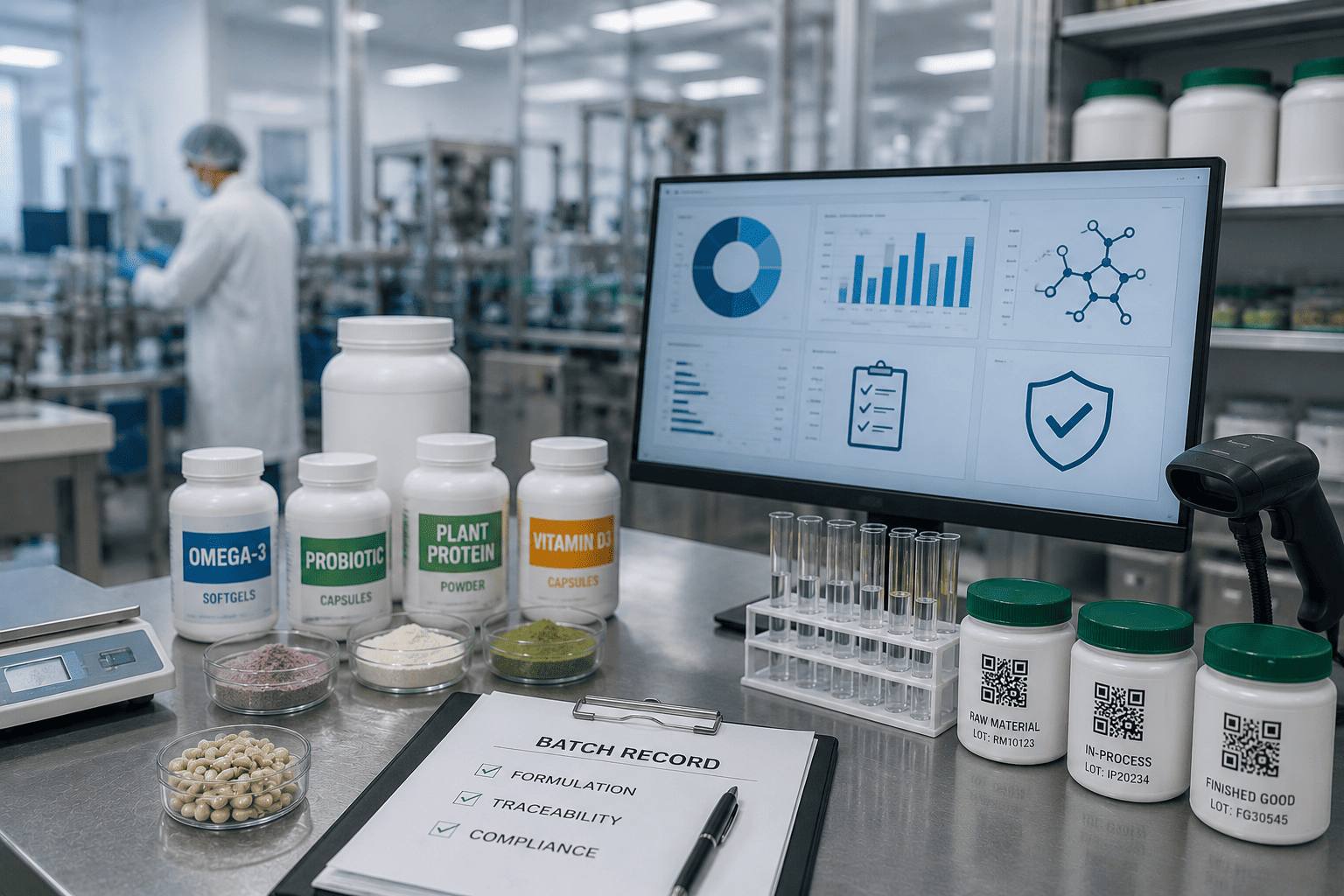
The nutraceuticals and functional foods sector sits at the intersection of food manufacturing and pharmaceutical-grade quality expectations. Consumers want proof of potency, purity, and provenance; regulators want documentation; and retailers want reliable, compliant supply. Generic ERP systems, or worse, a patchwork of spreadsheets and standalone quality software, cannot keep pace with these demands. This blog breaks down the specific ERP features that matter most for nutraceutical and functional food manufacturers, and why they are foundational rather than optional.
This is one of the fastest-growing segments of the broader food and beverage market. Consumer demand for immune support blends, adaptogenic beverages, protein-fortified snacks, and clean-label supplements has pushed many mid-market manufacturers into rapid growth, often faster than their systems can support. A company that started with a handful of SKUs and a QuickBooks-plus-spreadsheets approach can find itself, within a few growth cycles, managing dozens of formulas, multiple co-packers, and retail and direct-to-consumer channels simultaneously. At that point, the absence of purpose-built ERP functionality stops being an inconvenience and starts being a genuine business risk.
Why This Industry Needs Purpose-Built ERP Features
Nutraceutical and functional food products, from probiotics and protein powders to fortified beverages and adaptogenic blends, are manufactured under a mix of food safety rules and dietary supplement regulations. A single SKU may involve dozens of raw material lots, active ingredient potency ranges, allergen declarations, and label claims that must be substantiated. Manual tracking introduces risk at every one of these points. The right ERP platform closes those gaps by embedding compliance and quality directly into daily production workflows.
Three pressures make this industry distinct from general food manufacturing. First, potency matters as much as quantity: an ingredient that is chemically present but below its labeled potency threshold is a compliance failure, not just an inventory discrepancy. Second, claims substantiation is constant: every structure/function claim on a label needs to trace back to a validated formula and, often, supporting documentation the brand can produce on demand. Third, channel complexity is high: the same finished good may move through retail distribution, e-commerce fulfillment, and subscription-based direct-to-consumer shipping, each with different lot-tracking and documentation expectations from downstream partners.
Core ERP Features for Nutraceuticals and Functional Foods Manufacturing
1. Formulation and Recipe Management
Precise formulation control is the foundation of nutraceutical manufacturing.
- Multi-level bill of materials (BOM) support for base formulas, premixes, and finished blends
- Automatic yield and scaling calculations when batch sizes change
- Version control for formula revisions, with full audit history of what changed and when
- Ingredient substitution rules that respect potency, allergen, and cost constraints
2. Lot and Batch Traceability
Forward and backward traceability is non-negotiable for supplements and functional foods, both for recall readiness and for retailer/GFSI audit requirements.
- End-to-end genealogy from raw material lot to finished goods lot to shipped customer order
- One-click trace reports that identify every product affected by a specific input lot
- Expiration and potency-based inventory allocation (FEFO logic tied to active ingredient stability)
- Built-in recall simulation and reporting to demonstrate audit readiness
3. Regulatory and Label Compliance
Dietary supplements fall under 21 CFR Part 111 cGMP requirements, while functional foods may carry FDA food labeling and structure/function claim obligations.
- Specification management tied to raw material COAs and finished product release criteria
- Electronic batch records that capture deviations, approvals, and corrective actions
- Label and claim version control linked to formula changes, preventing mismatched packaging
- Supplier qualification workflows with expiration tracking on certifications and audits
4. Quality Control and Certificate of Analysis (COA) Management
Quality holds and release decisions need to happen inside the same system that manages inventory and orders, not in a disconnected quality database.
- Configurable inbound, in-process, and finished goods QC test plans
- Automatic quality holds that block non-conforming lots from shipping
- Digital COA generation and storage, searchable by lot number
- Non-conformance and CAPA (corrective and preventive action) tracking tied to specific batches
5. Inventory Visibility Across Potency and Shelf Life
Active ingredient potency degrades over time, which means inventory decisions cannot rely on quantity alone.
- Real-time inventory valuation that accounts for potency-adjusted usable stock
- Multi-warehouse and multi-bin visibility for climate-controlled or segregated storage
- Automated reorder points tied to both quantity and shelf-life thresholds
6. Multi-Channel Order and Fulfillment Management
Nutraceutical and functional food brands increasingly sell through a blend of retail distribution, e-commerce marketplaces, and subscription-based direct-to-consumer programs, often simultaneously.
- Unified order management across retail EDI, e-commerce platforms, and subscription billing
- Channel-specific lot allocation so retail and DTC orders draw from appropriately dated inventory
- Integrated demand planning that accounts for promotional spikes and subscription renewal cycles
- Consolidated financial reporting across channels without manual reconciliation between systems
7. Cost Accounting and Margin Visibility
Raw material costs for functional ingredients, adaptogens, probiotics, and specialty actives can be volatile, and formulas often change to manage cost without sacrificing label claims.
- Real-time landed cost tracking that reflects ingredient price fluctuations by lot
- Formula-level margin analysis that updates automatically when a BOM or supplier changes
- Standard and actual cost variance reporting to flag formulation drift before it erodes margin
Common Pitfalls When Systems Fall Short
Manufacturers that outgrow spreadsheet-based or generic accounting-software approaches tend to encounter the same set of problems, regardless of product category.
- Recall investigations that take days instead of hours because lot genealogy has to be reconstructed manually across disconnected files
- Label and claims mismatches when a formula is updated but packaging artwork isn’t automatically flagged for review
- Quality holds that are tracked in email threads, creating risk that a non-conforming lot ships before disposition is finalized
- Inventory write-offs from expired or under-potency stock that wasn’t flagged early enough for reformulation, discounting, or donation
- Duplicate data entry between a standalone quality system and the ERP, increasing the chance of transcription errors in audit-critical records
Each of these issues is preventable when formulation, quality, traceability, and fulfillment data live in a single, connected system rather than a collection of point solutions.
What to Look for in an ERP Evaluation
For manufacturers evaluating ERP platforms specifically for nutraceuticals and functional foods, a few evaluation criteria tend to separate systems that will hold up in production from those that will require workarounds within a year.
- Native support for potency-based and expiration-based inventory logic, not a bolt-on module
- Configurable electronic batch records that match your actual production steps, not a rigid template
- Proven integrations with third-party lab systems for COA data exchange
- Scalability to support co-manufacturing and toll manufacturing relationships as the brand grows
- An implementation partner with direct experience in dietary supplement and functional food environments
Comparing Generic ERP vs. Purpose-Configured ERP for Nutraceuticals
| Capability | Generic / Legacy ERP | Acumatica ERP (Configured for Nutraceuticals) |
| Formula & BOM control | Static BOMs, manual scaling | Dynamic multi-level BOMs with automatic yield scaling |
| Lot traceability | Partial, often spreadsheet-supplemented | Full forward/backward genealogy in real time |
| Quality holds | Manual, prone to human error | System-enforced holds blocking non-conforming shipments |
| Regulatory documentation | Disconnected from production records | Electronic batch records integrated with production |
| Shelf-life/potency tracking | Quantity-based only | Potency- and expiration-aware inventory logic |
eWorkplace Apps Quality Management Suite for Nutraceuticals
For nutraceutical and functional food manufacturers running Acumatica, the eWorkplace Apps Quality Management Suite extends native ERP functionality with purpose-built quality workflows that keep pace with cGMP and food safety obligations.
- Configurable inspection plans for incoming raw materials, in-process checks, and finished goods release
- Automated non-conformance and deviation workflows with routing for review and disposition
- Digital COA generation, storage, and retrieval directly linked to lot and batch records
- CAPA tracking with root-cause documentation to support third-party and regulatory audits
- Real-time quality dashboards that give operations and quality teams shared visibility into hold status and release readiness
By embedding these workflows directly inside Acumatica, manufacturers avoid the data gaps and duplicate entry that come with standalone quality systems, while maintaining the audit trail regulators and retail partners expect.
Choosing the Right ERP Partner
Selecting ERP features on paper is only part of the equation. Implementation partners who understand nutraceutical and functional food production, from formulation nuances to compliance documentation, help ensure the system is configured to match how your plant actually operates rather than forcing a generic template onto a specialized process.
The configuration work matters as much as the software license. Two manufacturers running the same ERP platform can have very different experiences depending on how well their electronic batch records, quality hold rules, and lot genealogy structures were mapped to their actual production floor during implementation. A partner who has configured Acumatica specifically for supplement and functional food producers before will recognize industry-specific requirements, such as potency-adjusted FEFO logic or claims-linked label version control, without needing to be walked through them from scratch. That experience typically translates into a faster go-live, fewer post-launch workarounds, and a system that quality and operations teams actually trust.
It is also worth evaluating how a prospective partner supports the system after go-live. Formulas change, regulations evolve, and new sales channels get added. An ERP configuration that cannot flex with those changes becomes a liability rather than an asset within a few years. Look for a partner who offers ongoing application managed services alongside the initial implementation, so the system continues to reflect how your business actually runs as it scales.
Ready to Modernize Your Nutraceuticals Operations?
Acuvera Tech helps nutraceutical and functional food manufacturers implement Acumatica ERP solutions built for formulation control, lot traceability, and regulatory compliance. With 36+ years of ERP implementation experience, our team can help you evaluate the right fit for your production environment.