
Why Disconnected PLM and ERP Is Costing Manufacturers Time and Money
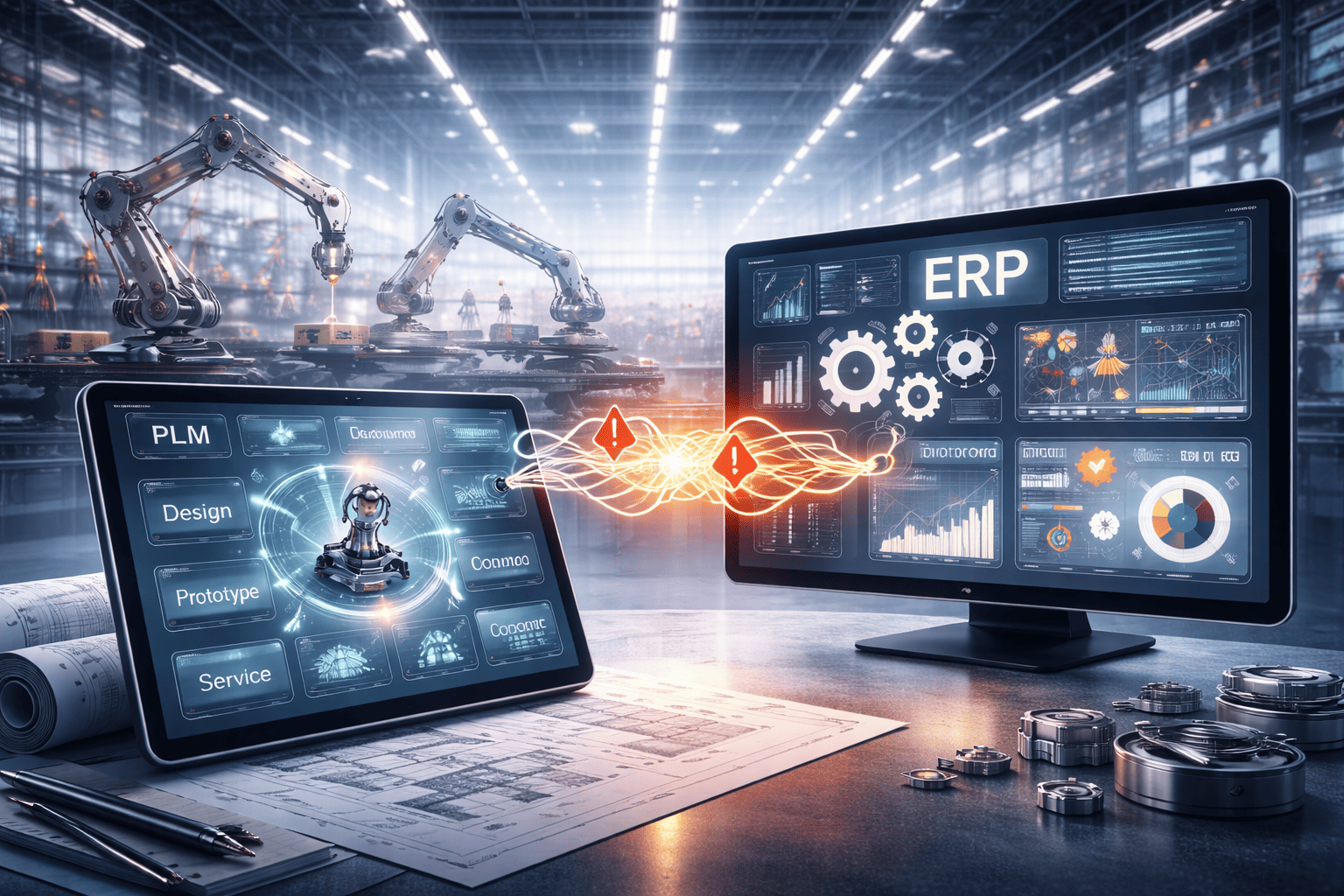
Most manufacturers run two critical systems in parallel – a Product Lifecycle Management (PLM) platform that governs design, engineering, and specification data, and an ERP system that manages production, procurement, inventory, and finance. In theory, these systems are complementary. In practice, they are often completely disconnected.
When PLM and ERP don’t talk to each other, the cost shows up in ways that are easy to overlook until they become too large to ignore: delayed product launches, production errors from outdated BOMs, redundant data entry across departments, and engineering change orders that take weeks instead of days. For mid-market manufacturers operating in competitive, margin-sensitive environments, this disconnect is not a minor inconvenience – it’s a strategic liability.
The Gap Between Design and Production
In a disconnected environment, the handoff from product development to manufacturing is a manual process. Engineers finalize a design in the PLM system, then someone – often manually – re-enters specifications, bills of materials (BOMs), and component details into the ERP. This creates an immediate point of failure.
It’s not just the risk of data entry errors, though those are common and costly. The deeper problem is version control. When changes are made on the engineering side, there’s no guarantee that the production floor is working from the current spec. A design revision that doesn’t propagate into ERP in time means materials are ordered, setups are configured, and production runs begin – all based on outdated information.
The result is waste: scrapped materials, rework, missed ship dates, and the kind of reactive firefighting that consumes operations leadership time and erodes customer trust.
What Integrated PLM-ERP Actually Looks Like
When PLM and ERP are properly integrated, product data flows automatically from design into production planning. BOMs created in the PLM system are pushed directly into ERP, eliminating double-entry and ensuring that procurement, scheduling, and shop floor operations are always working from the same source of truth.
Engineering change orders (ECOs) – one of the most time-consuming pain points in disconnected environments – become dramatically more manageable. When a design change is approved in PLM, the relevant ERP records are updated automatically. Materials requirements are recalculated. Open purchase orders are flagged. Production schedules are adjusted. What used to take days of cross-departmental coordination can happen in near real-time.
For manufacturers with complex, configurable products or frequent new product introductions, this kind of integration is not a nice-to-have. It’s a core operational requirement.
The Business Impact: Speed, Accuracy, and Cost
The measurable benefits of PLM-ERP integration cluster around three outcomes:
• Faster time-to-market. When product data moves automatically from design to production planning, new product introductions are compressed. Teams spend less time on coordination and more time on execution.
• Reduced errors and rework. Eliminating manual data re-entry removes a significant source of production errors. Integrated systems ensure that the product being built matches the product that was designed.
• Lower operational costs. Fewer errors mean less scrap and rework. Faster ECO processing means less production disruption. Automated data flows mean fewer FTEs dedicated to reconciling information across systems.
For product development and operations leaders under pressure to improve margins and accelerate launch cycles, these are not incremental gains – they represent a fundamental shift in how efficiently the business can execute.
Why Mid-Market Manufacturers Often Get This Wrong
Larger enterprises often have the resources to implement and maintain custom integration layers between PLM and ERP. Mid-market manufacturers typically don’t – and the solutions that were built years ago often don’t keep pace with platform updates, creating fragile connectors that break silently and are difficult to troubleshoot.
The other common failure mode is treating PLM-ERP integration as an IT project rather than a business initiative. Without clear ownership from operations and product leadership, integration efforts often stall at the technical layer and never deliver the cross-functional visibility that makes them valuable.
Successful integration requires mapping the actual workflows that span both systems – from new product introduction through engineering change management – and configuring the integration logic around those business processes, not just around data fields.
Choosing the Right Integration Approach
Not every manufacturer needs the same level of PLM-ERP integration. The right approach depends on factors like product complexity, change frequency, and the systems already in place. Some manufacturers benefit from a tightly coupled, real-time integration. Others do well with a more structured, batch-based synchronization model that fits their engineering and production cadence.
Modern ERP platforms like Acumatica are designed with open APIs and flexible integration frameworks that make connecting to PLM systems more straightforward than it used to be. The key is working with an implementation partner who understands both the technical requirements and the operational workflows that the integration needs to support.
The Bottom Line
Disconnected PLM and ERP systems are a tax on manufacturing performance. The costs accumulate in slower launches, higher error rates, excess rework, and the constant overhead of managing data across systems that don’t communicate. For manufacturers serious about improving speed-to-market and operational efficiency, integration is not an optional upgrade – it’s a foundation for competitive execution.
If your organization is evaluating how to close the gap between product development and production, Acuvera Tech can help you assess your current state and design an integration strategy that fits your environment.