
When the Recall Notice Arrives, How Long Does Your Trace Take?
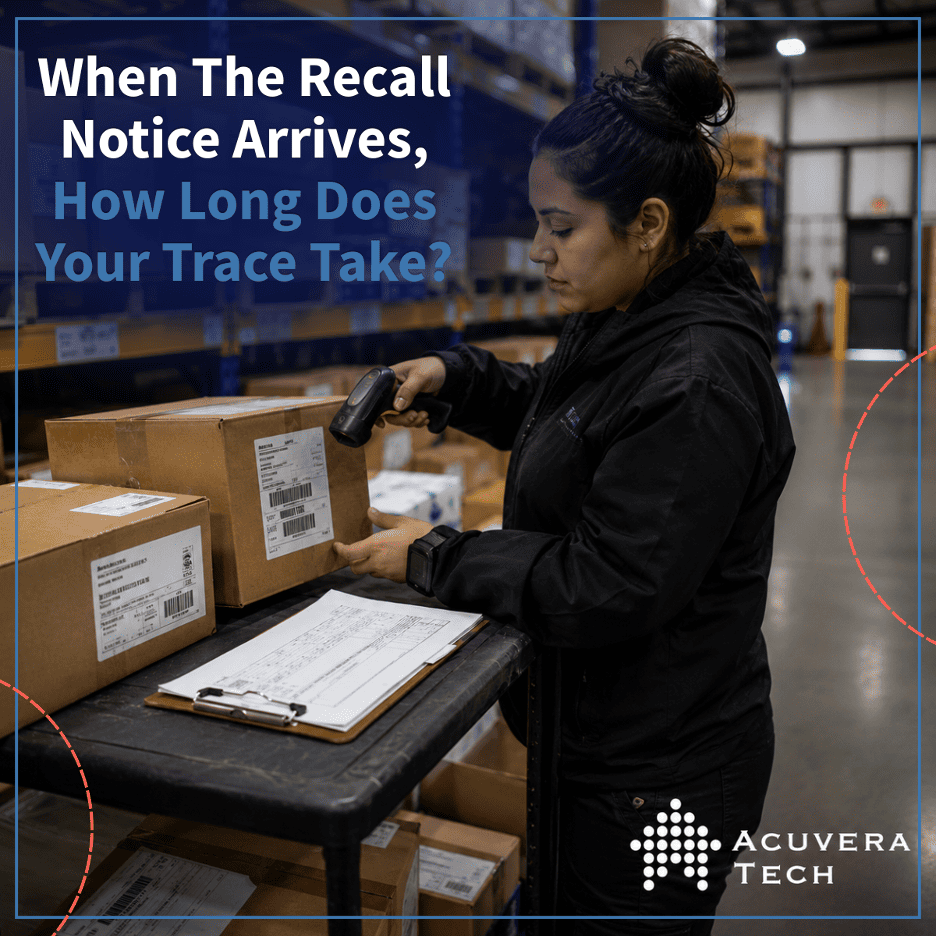
The notice comes in at 3:40 on a Friday. A manufacturer is pulling a lot of sterile procedure trays with one lot code, a date range, and a request. The request is that you identify and quarantine anything you still hold and notify every customer who received product from that lot. No small feat.
Your operations lead opens a spreadsheet.
It’s a good spreadsheet. Somebody built it carefully, years ago, and it has been maintained by hand ever since. It has a tab for each branch, a column for lot numbers, and a column for expiration dates that is mostly filled in. What it does not have is a reliable link between the lot you received and the specific customers you shipped it to. That link lives in the ERP’s shipment history, and the ERP was never told which lot went on which pick.
So now, the trace becomes a reconstruction. Someone pulls receiving records, someone else pulls packing slips, and a third person calls the branch in the next state to ask what they remember. By Monday, you have something you’re 80% confident in, and you spend Tuesday deciding whether that’s enough to send a customer notification on.
Every distributor who has been through this remembers it, and most of them go back to the spreadsheet afterward, because the alternative of actually changing how the business captures lot data feels like a much bigger project than the recall was.
The real cost of the status quo
The recall is the dramatic version of the problem. It’s also the least frequent version. The spreadsheet costs you far more in the easy weeks.
Time-to-trace is the number that matters, and most distributors don’t know theirs. We don’t mean, “can we trace it”. Everyone can, eventually. But how many hours of how many people’s time does it take, and will the answer hold up under scrutiny? If your device lines include products subject to FDA tracking orders, 21 CFR § 821.30 obligates distributors to provide the tracking manufacturer with specific information. This includes the UDI, lot, batch, model or serial number and the date received, and gives multiple distributors five working days to respond to a manufacturer request, and ten working days to respond to FDA. Five working days is not a lot of time to reconstruct history from packing slips. And unfortunately, recalls are not rare events in this industry: GAO found FDA oversaw 3,934 medical device recall events between fiscal years 2020 and 2024, all of them manufacturer-initiated (GAO-26-107619).
Expired stock is a write-off you schedule rather than prevent. When expiration dates reside in a spreadsheet instead of driving allocation, picking defaults to whatever is closest to the door. That’s FIFO at best, and often not even that. Product expires on the shelf in one branch while the same item is short in another, and nobody sees it until the quarterly count. The write-off gets booked, the CFO asks about it, and the answer is always some version of “we’re working on the process.”
FEFO isn’t a preference in this vertical is the whole job. First-expiry-first-out only works if the system knows the expiration date at the moment of allocation. Added to your system afterward makes it a human check, which means there’s also a human error rate. Ship short-dated product to a hospital customer and you don’t get a polite correction; you get a return, a credit, and a note in someone’s vendor file.
Chargebacks and contract compliance quietly erode margin. GPO and IDN agreements come with documentation expectations that spreadsheets satisfy poorly. Reconciling what you shipped against what you’re entitled to claim becomes a monthly manual exercise, and the claims you can’t substantiate you simply don’t file. Nobody tracks that number, which is exactly why it grows.
The audit burden is real, and it’s carried by one person. In most distributors this size, there’s a single individual who knows how the tracking workbook actually works. They know which tabs are current, which formulas are load-bearing, and which conventions everyone else forgot. That person is a genuine asset and a genuine single point of failure. When they take vacation, traceability slows down. When they leave, it stops completely.
And underneath all of it: customer trust. Distributors in this market don’t usually lose accounts over price. They lose them over a compliance officer at a long-time hospital customer asking a documentation question and getting a slow, hedged answer. That’s the moment a competitor gets invited into the conversation. A relationship you’ve held for fifteen years doesn’t end in a bid. Instead, it ends in a series of small credibility withdrawals, and lot traceability is one of the largest.
What good looks like
The fix isn’t a better spreadsheet. It’s making lot and expiration data a byproduct of transactions your team is already doing.
Capture at receipt, carried through. Lot and serial numbers, expiration dates, and UDI where applicable are captured when the product hits the dock, scanned, not typed, and then travel with the item through pick, pack, ship, and invoice without anyone re-entering them. The lot on the invoice is the lot in the box because the system never let them diverge.
Expiration-date-driven allocation. FEFO becomes the default rule the system applies, not a habit the picker remembers. Short-dated inventory surfaces before it becomes a write-off, and visibility spans branches, so stock about to expire in one location can be moved rather than binned.
Traceability in one query, both directions. Forward: this lot went to these customers on these orders. Backward: this customer received product from these lots. Same query in minutes. That’s the difference that will prevent the recall from becoming a crisis.
Audit trail as exhaust, not as effort. Because the data is captured in the normal flow of work, the documentation an auditor or a manufacturer asks for already exists. Nobody assembles it.
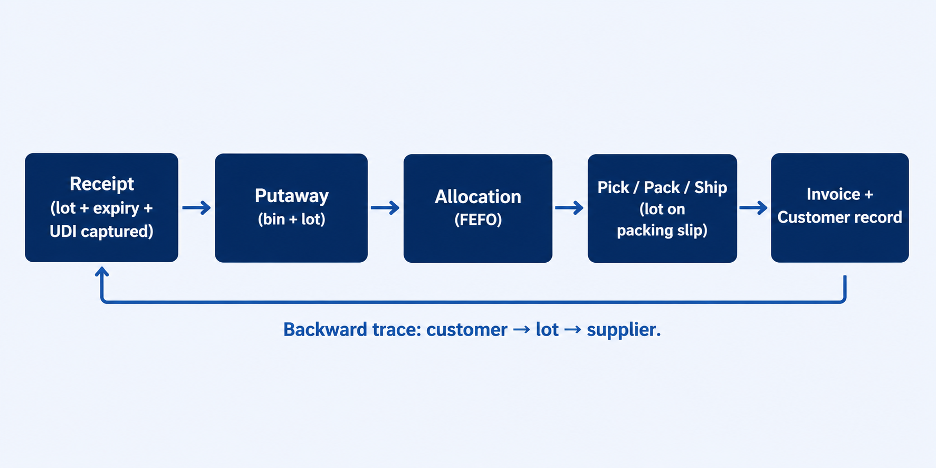
This is the operational model Epicor Prophet 21 is built around for distributors who need lot and serial control, expiration-driven allocation, and traceability as native functionality rather than a bolt-on module. Acuvera Tech implements P21 for mid-market distributors, and it’s worth being honest about where the difficulty actually sits: the software handles lot tracking well. The hard part is data migration, and deciding how much historical lot and shipment history comes across, in what shape, and how you reconcile years of spreadsheet conventions against a structured system. That’s the work that determines whether you go live with real traceability or with a clean system and an archive nobody can query. It’s the part we spend the most time on, and the part most implementation timelines underestimate.
If this sounds like your Friday afternoon
You don’t need to have a project scoped to have the conversation. If you want to talk through what lot and expiration tracking looks like in a system that was designed for it, including an honest and free read on migration effort for your history, Joe Schuman at Acuvera Tech runs a 30-minute working session. No deck, no pressure.