
Tariff Refunds Are Moving. Can Your Data Keep Up?

The tariff story changed. Your books may not have.
Distribution leaders: on October 6, U.S. Customs opened the third and final phase of its IEEPA tariff refund process.
For most of 2025, tariff costs flowed into your business through supplier invoices, surcharges, and landed cost. Now some of that money is flowing back. The question is no longer “what did tariffs cost us?” It’s “can we prove it, line by line, across every branch?”
What happened, in plain terms
In February, the Supreme Court ruled the tariffs imposed under the International Emergency Economic Powers Act (IEEPA) unlawful. Customs estimates it collected about $166 billion under them between February 2025 and February 2026 (Federal Register).
Refunds don’t arrive automatically. Importers file claims through a Customs system called CAPE, which opened in April. The newest phase, for older entries, applies only to importers with court orders (Sovereign Magazine, citing CBP’s court filing).
Here’s the detail that should catch a distributor’s attention. Of 27.2 million entries claimed so far, 6.1 million failed Customs’ checks. Common reasons: the claim missed a filing window, lacked the tariff code used to assess the duty, or had already been claimed (same source).
This is a data problem before it’s a cash problem
Those rejections weren’t about the law. They were about records. And records are where multi-branch distributors tend to struggle most.
Think about how tariff costs actually entered your business last year:
- Some came direct. If you imported, duties hit your landed cost on specific receipts.
- Some came through suppliers. A manufacturer added a tariff surcharge, and you may or may not have tracked it separately from a normal price increase.
- Some you passed on. You raised customer prices, adjusted contracts, or absorbed the hit to keep an account.
If each branch handled that differently, or if an acquired location still runs on its own system, the answers live in spreadsheets, emails, and someone’s memory.
That raises questions we can’t answer for you in a blog post. If a supplier receives a refund, will any of it come back to you? If a refund lands on your books, what happens to the margin on product you already sold? And if customers ask whether a tariff surcharge should now come off their price, do you know which of your increases were tariff-driven?
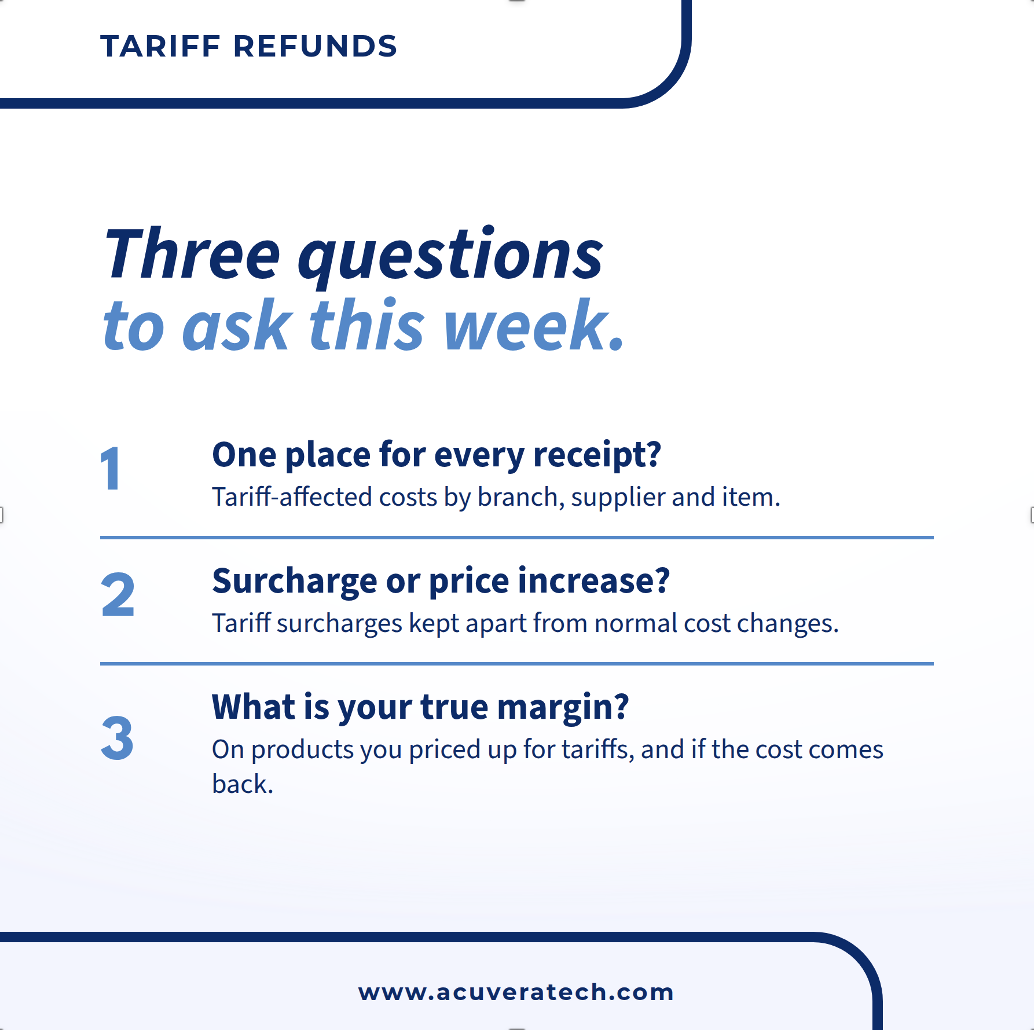
Three questions to ask your team this week
- Can we pull every tariff-affected receipt from 2025 by branch, supplier, and item, from one place?
- Can we separate tariff surcharges from regular cost increases in our purchasing history?
Do we know our true margin on products we priced up for tariffs, and what it would be if that cost came back?
If the honest answer to any of these is “it depends who you ask,” you’re not alone. It usually means your systems were never designed to hold the answer in one place. Refund eligibility and tax treatment are questions for your customs broker and CPA. Whether your data can support them is a systems question.
Let’s talk through your situation
Every distributor’s tariff exposure looks different, and the right next step depends on how your branches, suppliers, and systems fit together. That’s a conversation, not a checklist.
Our Solution Consultant, Joe Schuman, works with multi-branch distributors on exactly these visibility gaps, including those evaluating Epicor Prophet 21. Thirty minutes, no pitch deck: just your questions and an honest read on where your data stands.
We want you to be successful, especially when the rules keep changing.