
Clean Data Beats Another AI Tool and I’ll Tell You Why

Two distributors buy the same pricing engine. A year later, one is running quotes off it and the other stopped opening the dashboard. Distribution Strategy Group (DSG), the research firm behind this year’s AI Execution Gap report, found this exact pattern across the 300-plus distributors it evaluated and the difference was almost never the software.
It was the data underneath it.
The number that should change how you budget
DSG’s survey of 233 distribution executives found that companies reporting strong data governance were dramatically more confident in their AI investments than companies working with fragmented or inconsistent product, customer, or pricing data.
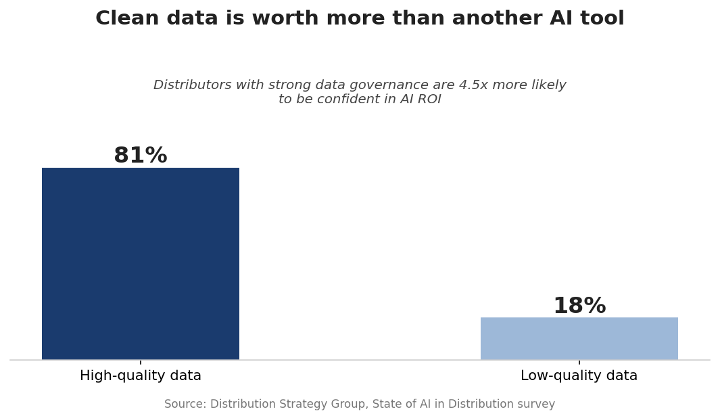
Eighty-one percent of distributors with high-quality data said they’re confident in their AI return on investment. Among distributors working with low-quality data, that number drops to 18% and DSG puts the gap at 4.5 times. Same software category, same generative-AI wave, wildly different confidence, because one group could truly trust the inputs.
Why this is the habit that matters most
AI has a skill for amplifying bad data. Duplicate customer records, inconsistent pricing history, and incomplete product content don’t cancel out once you point a model at them. DSG’s research found they become more visible, faster, because the tool now surfaces every error at scale.
That’s consistent with what DSG heard directly from distributors when it asked what’s actually slowing AI adoption down. Skills gaps and change resistance topped the list with 52% of respondents combined. DSG’s chief operating officer, Brian Hopkins, noted it’s a people problem before it’s a technology problem. But poor or incomplete data ranked right behind them, ahead of budget uncertainty and legacy system integration.
What this looks like for a company your size
Start with one dataset, not all of them. The distributors DSG profiled in its top tier spent years standardizing product information and consolidating customer records before scaling AI. You don’t need a multiyear data program to start. You just need to pick the one dataset (pricing history, product content, or customer master records) that’s feeding the decision you care about most, and fix that one first.
Assume your current data will get exposed, not fixed, by AI. If a pricing tool or a forecasting model surfaces something that looks wrong, treat that as the tool doing its job. That’s usually the first honest signal you’ve gotten about a data problem that’s been going unnoticed.
Put a number on it before you buy anything else. DSG found the strongest programs measured AI against ordinary business metrics, such as forecast accuracy, response time, inventory turns. Before adding a new AI application, ask what’s really blocking the metric you want to move. Frequently, the report suggests, it’s the data feeding the tool you already have.
This is also, not coincidentally, the least glamorous part of any AI conversation. Nobody presents a keynote on cleaning up duplicate SKU records. But it’s the part DSG’s own research says determines whether the rest of the investment pays off.
Where to start
If you read Wednesday’s piece on the six habits DSG found across the companies making AI work, this is the one worth acting on first. Our Solution Consultant, Joe Schuman, is happy to walk through where your own product, pricing, or customer data actually stands today.
Sources
Every statistic and quotation traces to: Distribution Strategy Group, “The AI Execution Gap: Why Only a Handful of Distributors Are Getting AI Right,” © 2026 Distribution Strategy Group (distributionstrategy.com)