
Manufacturing Is Growing Again. Is Your ERP Ready to Plan for It?
U.S. manufacturing is growing again, and it has been for most of this year. The takeaway for small and mid-sized manufacturers and distributors: the planning habits that got you through a slow stretch may not hold up when orders pick up. Now is a good time to make sure your ERP is planning from today’s demand, not last year’s.
We’ve been watching the monthly numbers all year, and this week’s report stood out.
What changed this week?
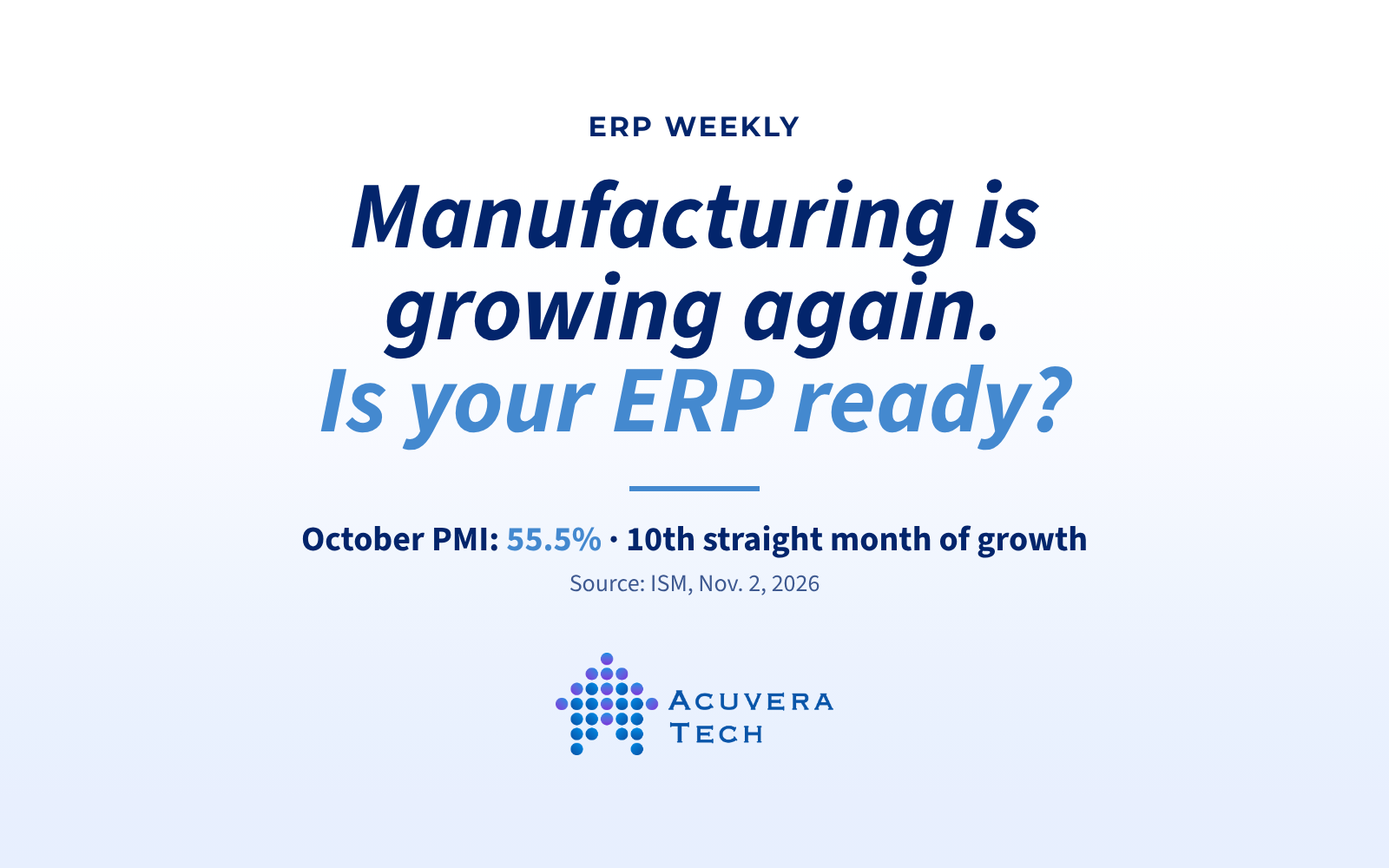
On November 2, the Institute for Supply Management (ISM) reported its Manufacturing PMI at 55.5% for October. That marks the 10th straight month of expansion. For context, ISM’s reading for October 2025 was 48.7%, the eighth month of contraction at that point.
A swing like that shows up on the shop floor and in the warehouse. More orders mean more purchase orders, more jobs to schedule and more chances for a stockout or a late shipment.
Why does a rebound put pressure on ERP planning?
Many shops spent the downturn trimming inventory and tightening reorder points. That made sense then. The catch is that min/max levels, safety stock and lead times set during a slow period can quietly stay in the system.
According to Acuvera Tech’s implementation consultants, this is one of the most common gaps they see. The ERP is doing exactly what it was told, but it was told to plan for a different market. The result is buyers working around the system in spreadsheets, which is hard to keep up with when volume rises.
Where should manufacturers and distributors look first?
Our consultants suggest starting with a few areas that tend to drift:
- Supplier lead times. If vendor lead times in your ERP haven’t been updated in months, MRP and purchasing suggestions will be off.
- Reorder points and safety stock. Review them against recent demand, especially for your fastest-moving items.
- Pricing and cost updates. When input costs move, quotes and price lists built on old costs can erode margin before anyone notices.
- Capacity and scheduling. For manufacturers, check that work center capacity and routings reflect how the floor actually runs today.
What should we do now, before the new year?
A few practical steps for the next 30 to 60 days:
- Pull a list of your top 50 items by volume and compare their planning settings to the last 90 days of actual demand.
- Ask your buyers which vendor lead times they no longer trust, then fix those records first.
- Schedule a quick cost and price review so quotes reflect current costs going into 2027.
- Note where your team relies on spreadsheets instead of the ERP. Each one is a clue about where the system’s setup needs attention.
None of this requires a new system. Most of it is cleanup and tuning inside the ERP you already run, whether that’s Epicor Kinetic or Epicor Prophet 21.
Want a second set of eyes?
If you’d like help checking whether your planning setup is ready for steadier demand, book 30 minutes with Joe on our team.