
You Won the Job. Did You Make Money on It?

The machine shipped in June and is running at the customer’s plant. It passed acceptance and the final invoice cleared. By every measure that shows up in a status meeting, it was a good job.
Now to ask the harder question. What did it actually cost to build?
In most industrial machinery shops, the honest answer is a range. Somewhere near the estimate, probably a little over, hard to say exactly. The estimator quoted 640 hours a the floor booked something like 780, though a stretch of that got charged to a general work order during the two weeks a few jobs overlapped. Engineering revised the drive assembly twice after release, and nobody repriced. There was a week of rework in final assembly that everyone remembers, but no record captures.
So the machine made money, or it made less money than it looked like, or it lost money and was carried by the other two jobs that ran clean. Nobody in the building can say which, and the next quote goes out Tuesday. Still with us?
The Compounding Problem
Here is what makes custom order costing different from almost every other operational gap: it feeds itself.
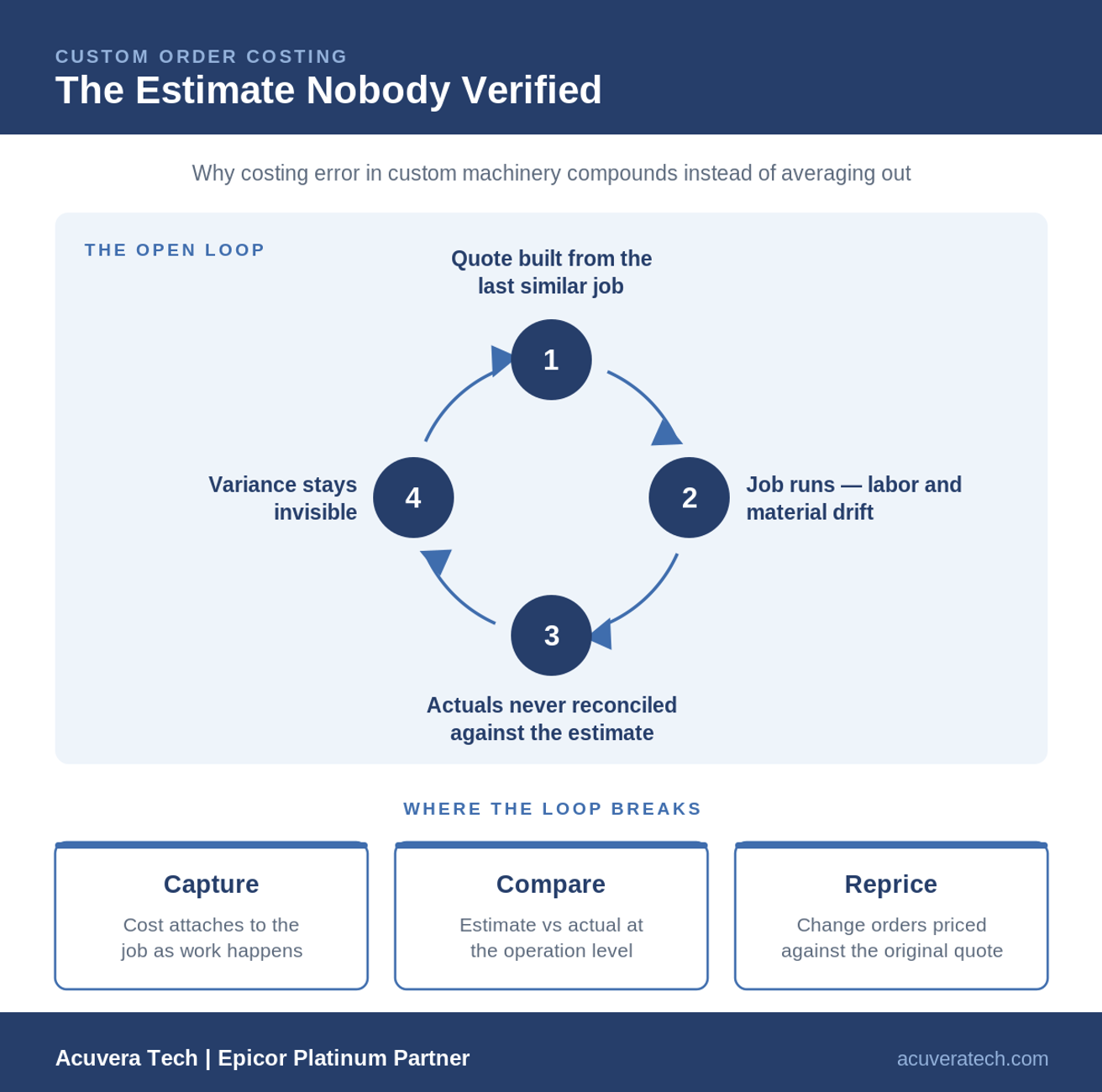
When an estimator prices a new machine, they start from the closest thing they have built before. That’s the only sane way to quote a one-off with the systems they’re running. But if the actual cost of that reference job was never reconciled against its estimate, the estimator is copying an estimate whose accuracy was never confirmed. The error does not stay put. It gets inherited, adjusted slightly, and passed forward into the next quote, and the one after that.
A shop can run this way for years without anything looking broken. Revenue will grow and the backlog stays healthy. Then margin drifts down half a point at a time, and because no single job is ever proven to be the culprit, the explanation lands on steel prices, or the labor market, or a customer who is just difficult to work with.
The pattern shows up in a specific way in machinery: the jobs that hurt most are the ones closest to something you have done before. A genuinely novel machine gets scrutiny, contingency, and a careful estimate. The near-repeat gets quoted from memory in an afternoon and the fifteen percent that is different from last time is exactly where the cost hides.
What Accurate Costing Actually Requires
You thought we were going to say more discipline, didn’t you? No, not more discipline. Shops that struggle here are usually working without a mechanism, and discipline without a mechanism just means someone maintains a very good spreadsheet until they leave. Three things have to be true. Cost has to attach to the job as work happens. Estimate and actual have to sit side by side at the operation level. And when engineering changes the scope, the price has to be able to move with it.
This is the work Epicor Kinetic is built to do for custom and engineer-to-order manufacturers. Job costing runs at the job and operation level, so estimated hours and actual hours are visible against each other while the job is still open and something can still be done about it. Shop floor data collection books labor and material against the operation being performed rather than a catch-all bucket, which is what makes the variance meaningful instead of directional. Configurator-driven quoting builds estimates from rules and current cost data rather than from the last similar job, which breaks the inheritance problem at its source. And change orders can be repriced against the original quote, so a mid-build revision becomes a commercial event rather than an absorbed cost.
None of that makes a hard job easy. Custom machinery is genuinely difficult to estimate, and it always will be. What it does is close the loop so the difference between what you quoted and what it cost becomes information you can use on the next quote.
The test
Pick the last three machines you shipped. Ask for estimated versus actual cost on each, broken out by operation, by end of day.
If that arrives by end of day, your loop is closed and your next quote is standing on something real. If it takes a week and arrives with caveats, the estimate you send Tuesday is built on a number nobody has verified, and you will find out whether it was right or wrong roughly six months from now.
If that sounds familiar, it is worth a conversation. You can book thirty minutes with our experienced solution consultant.