
Why Retail Returns Are Draining Profitability - and How ERP-Driven Reverse Logistics Fixes It
The Return You Don’t See Coming
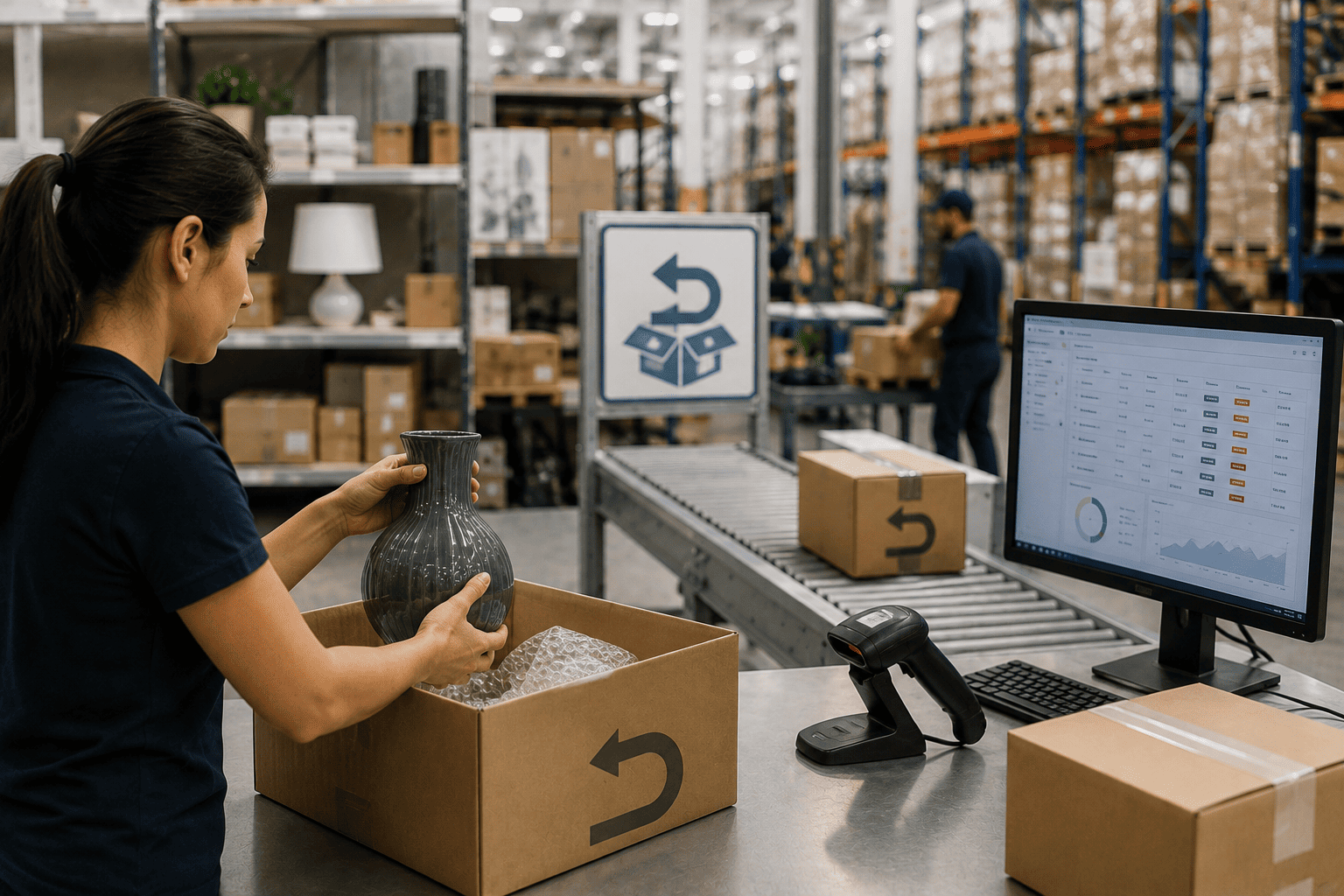
Every retailer plans for sales. Far fewer plan, with the same rigor, for what happens after a customer decides to send something back. Returns have quietly become one of the most expensive and least controlled parts of retail operations, particularly as online and omnichannel selling have expanded the number of ways a return can enter the business – in-store, by mail, through a marketplace, or via a third-party carrier drop-off.
The cost isn’t just the refund itself. It’s the labor to process the item, the days it sits unsellable while someone decides what to do with it, the shipping and handling expense, and the customer experience damage when a refund takes too long. Most of that cost is avoidable – but only if the process behind it is actually connected.
Where Reverse Logistics Friction Shows Up
Talk to retail operations teams about returns, and the same frustrations surface again and again:
• Channel silos – a return initiated online and one initiated in-store often flow through entirely separate processes, making it hard to see total return volume or trends in one place.
• Inconsistent disposition decisions – whether an item goes back on the shelf, gets refurbished, is liquidated, or is written off frequently depends on whichever employee happens to process it that day.
• Slow restocking – returned goods can sit in a back room or receiving dock for days before inventory systems reflect that the item is sellable again, creating phantom stockouts on items that are technically back in the building.
• Refund delays – when the returns process isn’t tightly linked to the original order and payment system, matching a return to the right refund or store credit becomes a manual, error-prone task.
• Little to no root-cause data – without structured capture of why an item was returned, merchandising and quality teams lose one of their best sources of insight into product or sizing problems.
• Return fraud and abuse exposure – disconnected systems make it harder to spot patterns like serial returners or wardrobing, since there’s no unified view of a customer’s return history across channels.
Why Spreadsheets and Legacy Point Solutions Fall Short
Many retailers manage returns with a patchwork of point-of-sale overrides, e-commerce platform return portals, and manual spreadsheets that someone reconciles at the end of the week. Each piece may work adequately in isolation, but none of them talk to each other in real time. The result is a returns process that depends heavily on people remembering to update multiple systems correctly – which is precisely where errors, delays, and lost visibility creep in.
As transaction volume grows or a retailer adds new selling channels, this patchwork approach doesn’t scale. It simply produces more disconnected data points that no one has time to reconcile, and the true cost of returns becomes increasingly difficult to even measure, let alone manage down.
What Unified, ERP-Native Reverse Logistics Looks Like
An ERP-native approach to returns, such as the retail-commerce capabilities built into Acumatica, treats a return as a single transaction that touches inventory, finance, and customer service simultaneously – regardless of which channel it originated from. In practice, that means:
• Every return, from any channel, recorded against the same customer and order history in one system.
• Rules-based disposition workflows that automatically route items toward restock, refurbishment, liquidation, or disposal based on condition and policy – not individual judgment calls.
• Inventory that updates to sellable status as soon as disposition is confirmed, closing the gap between a return arriving and it being available to sell again.
• Refunds and store credits that post automatically against the original order, eliminating manual matching between systems.
• Structured return-reason data captured at the point of return, feeding directly into merchandising, quality, and vendor scorecard analytics.
Manual Returns Handling vs. Unified ERP-Native Reverse Logistics
| Operational Area | Manual, Disconnected Returns Handling | Unified ERP-Native Reverse Logistics |
| Channel Visibility | Store, e-commerce, and marketplace returns tracked in separate systems | One returns record spans every channel in real time |
| Disposition Decisions | Staff judgment call on restock, refurbish, or write-off, often inconsistent | Rules-based workflow routes each item to the right disposition automatically |
| Time to Restock | Returned goods sit in receiving for days before inventory updates | Sellable stock updates as soon as disposition is confirmed |
| Refund and Credit Processing | Manual matching between return, order, and payment system delays refunds | Refunds and credits post automatically against the linked original order |
| Root-Cause Visibility | Return reason data is inconsistent or not captured at all | Structured return-reason analytics feed back into buying and quality decisions |
Returns as a Competitive Differentiator, Not Just a Cost Center
It’s worth reframing what a well-run returns process actually delivers, because the conversation often stays narrowly focused on cost reduction. A retailer that can process a return quickly, refund a customer without delay, and get a returned item back on the shelf or into the right disposition channel within a day or two isn’t just controlling expense – it’s building the kind of experience that increasingly influences where customers choose to shop in the first place.
Retailers with lenient, transparent return policies often see it reflected directly in purchase confidence, since customers are more willing to buy when they trust the return process will be straightforward if needed. A slow or confusing returns experience does the opposite – it erodes trust even when the original purchase went well, and it shows up in customer reviews and repeat purchase rates in ways that are hard to trace back to their root cause.
Treating reverse logistics as a strategic capability, backed by the same real-time visibility and automation applied to forward-facing sales operations, turns what has historically been viewed purely as a loss center into a functioning part of the customer experience and the inventory strategy alike.
What This Means for the Bottom Line
Treating reverse logistics as a first-class, connected process – rather than an afterthought bolted onto the sales process – changes what returns cost a retail business:
• Faster restocking turns dead inventory back into sellable stock days sooner.
• Consistent disposition rules reduce write-offs caused by inconsistent, ad hoc decisions.
• Faster, more accurate refunds improve customer trust and reduce service escalations.
• Return-reason analytics give merchandising teams a real feedback loop instead of anecdotal guesses.
• A single cross-channel view makes it far easier to spot abuse patterns and control shrinkage.
For retailers evaluating where operational investment will move the needle fastest, reverse logistics is often overlooked – yet it’s one of the few areas where better process design pays back in customer experience, margin protection, and inventory accuracy all at once.
Signs Your Returns Process Has Outgrown Its Systems
Returns friction tends to build gradually, which is part of why it’s so easy to underestimate. A handful of patterns are reliable indicators that a retailer’s current process has fallen behind the volume and complexity it’s actually handling:
• Customer service regularly fields questions about refund status because no one can quickly confirm where a return is in the process.
• Store teams and e-commerce fulfillment teams work from different return policies or timelines because their systems were never unified.
• Finance closes the books each month with unresolved return-related discrepancies between inventory and payment records.
• Merchandising can’t answer basic questions about why a specific product is being returned at a higher-than-normal rate.
• Seasonal return spikes – post-holiday being the clearest example – overwhelm staff because the process depends on manual handling rather than a scalable workflow.
Individually, each of these might look like a minor operational annoyance. Together, they describe a returns process that is absorbing far more labor and margin than it should, simply because the underlying systems were never built to treat returns as a connected, end-to-end workflow.
What an Implementation Actually Involves
Consolidating returns management into a unified ERP platform is a more approachable project than most retail operations teams expect, particularly when the rollout is phased around existing channels rather than attempted as a single big-bang cutover.
A typical implementation begins by documenting current return policies, disposition rules, and channel-specific workflows in detail, so the new system reflects real business rules rather than a generic default. Return reason codes are standardized across channels, disposition workflows are configured to route items automatically based on condition and policy, and integration points with point-of-sale, e-commerce, and payment systems are built so that a return, a refund, and an inventory update are always tied to the same transaction record.
Staff training tends to be lighter than expected, since the goal of a well-configured system is to reduce the number of judgment calls an employee has to make – the workflow itself enforces consistency. Running the new process alongside existing methods for a short transition window lets teams validate that disposition rules and refund timing behave as expected before fully retiring manual workarounds.
Turn Returns From a Cost Center Into a Controlled Process
Acuvera Tech helps retailers implement Acumatica ERP with unified, cross-channel returns management, so reverse logistics stops draining margin and start-to-finish visibility replaces guesswork. Talk to our team to see how a connected returns process fits your operation.