
Shop Floor Visibility: How Manufacturers Use Epicor to Eliminate Production Surprises

In industrial machinery and equipment manufacturing, surprises travel fast. They make their way into delivery commitments, customer relationships, and margin.
Things happen. Sometimes a machine goes down unexpectedly or a job falls behind schedule. Maybe a materials shortage surfaces three days after it should have been caught. By the time it reaches the VP of Operations or lands on the CEO’s desk, the damage is already in motion. The ultimate goal is for your systems to catch these surprises before they compound.
That’s the problem shop floor visibility solves, and it’s why manufacturers running Epicor Kinetic are replacing reactive firefighting with something more durable: Digital Guardrails that prevent waste during production, so every shift protects margin.
The Real Cost of Late Detection
Most manufacturers aren’t flying completely blind. They have data in the form of job traveler sheets, operator logs, supervisor reports, end-of-shift summaries. But these platforms also come with latency. By the time that information reaches operations leadership, it’s historical data. You’re seeing what happened on the floor instead of what is happening.
That gap is where margin disappears.
Now you have scrap already in the dumpster before the problem is detected. Downtime caused a missed delivery before it’s flagged in a report. Process variation has already compounded across three shifts. For VP of Operations and CFO audiences, this has a direct financial translation: manufacturers are losing 40–45% of paid capacity to scrap, downtime, and variation, and most of it is happening between shifts, between operators, and between the ERP system and the shop floor.
For industrial machinery and equipment manufacturers specifically, the stakes are compounded by complexity. Production runs are long. A single delayed job can cascade into downstream scheduling, subcontractor commitments, and customer delivery windows that took months to negotiate.
Three Conditions That Have to Be True for Every Shift
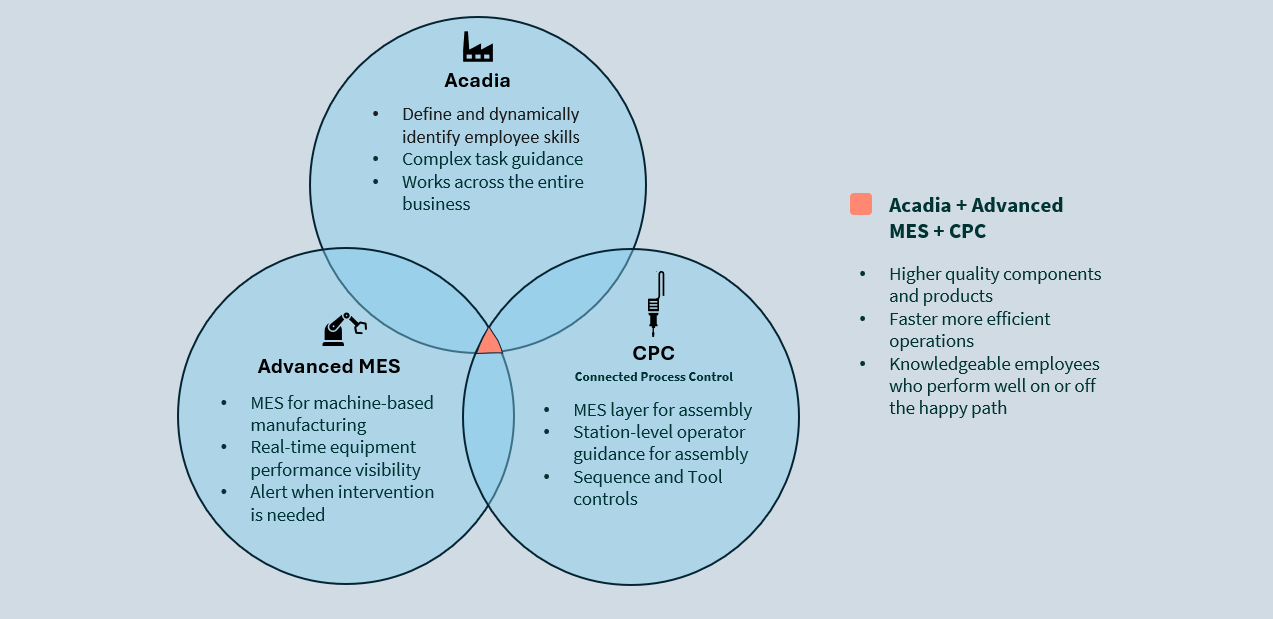
The Epicor Connected Shop Floor Bundle is built around a straightforward premise: three operational conditions must be true regardless of shift, operator, or location. When they’re not, margin erodes. When they are, it compounds.
Condition one: Real-time production visibility.
Epicor’s Advanced MES (AMES) provides live operational visibility and machine performance data. This means you get a continuously updated picture of shop floor reality. When a job falls behind, it surfaces immediately. When equipment is trending toward a performance threshold, leadership sees it before it becomes an unplanned failure.
Condition two: Tool-level process control.
Connected Process Control (CPC) moves quality enforcement upstream into the production cycle itself. It physically locks tools and sequences to validated specifications, replacing manual logs and memory-based assembly with a system that makes a wrong move impossible.
For machinery and equipment manufacturers where a single non-conformance can affect a capital equipment order a customer has waited months for, catching it at the point of production is categorically different from catching it at final inspection. The quality tax, i.e. rework costs, late shipments, and audit exposure gets paid either way. CPC moves when you pay it from after-the-fact to never.
Condition three: Standardized process execution.
This is the one most manufacturers underestimate. Visibility tells you what’s happening. Process control prevents errors at the tool level. But neither one addresses the most persistent source of variation in high-mix discrete manufacturing: inconsistent human execution across shifts, operators, and facilities.
Acadia delivers standardized execution through just-in-time digital work instructions and on-the-job training. This ensures every operator follows the validated Gold Standard process, not the version they were trained on by someone who retired six months ago. This is the mechanism that makes improvements stick.
From Reactive to Anticipatory Operations
The manufacturers most exposed to production surprises share a common profile: modern equipment, continuous improvement programs, capable people, and systems that surface problems after the damage is done.
Reactive manufacturing organizations are constantly managing the present. They stay busy chasing jobs, firefighting shortages, explaining delays to customers. Anticipatory organizations are managing the near future. They are able to spend their time identifying constraints before they become crises, allocating resources with full information, and delivering accurate customer commitments rather than optimistic estimates that have to be walked back.
That distinction has a direct financial translation for operations leadership. On-time delivery performance is a competitive differentiator in a market where customers make capital equipment decisions that affect their own production for years. Expediting costs are margin erosion that never appears on a budget line but accumulates steadily shift after shift. And customer trust, once damaged by delivery failures, is expensive to rebuild.
The Connected Shop Floor Bundle gives leadership the intelligence and the guardrails to navigate that complexity on the front foot, and to build operational gains that persist beyond individual employees and continue to improve over time.
The Question Worth Asking
If production falls behind schedule today, how long before you know?
For manufacturers still relying on manual reporting and end-of-shift summaries, the honest answer is often hours. For manufacturers with real-time shop floor visibility and digital process enforcement, the answer is minutes, and the deviation that caused it is already being corrected.
That delta is the operational moat. The shop floor has always generated data. What you and your team should be asking at the next meeting is: whether your systems are surfacing this data at the speed decisions need to be made, and whether your processes are enforced consistently enough that the decisions you made yesterday are still holding today.
Acuvera Tech is an Epicor partner specializing in ERP implementation for manufacturing and distribution. We implement Epicor Kinetic and Prophet 21 for mid-size operations across North America. Have questions, Schedule a complimentary consultation.