
From Field to Finance: Building a Connected Agriculture Enterprise with ERP
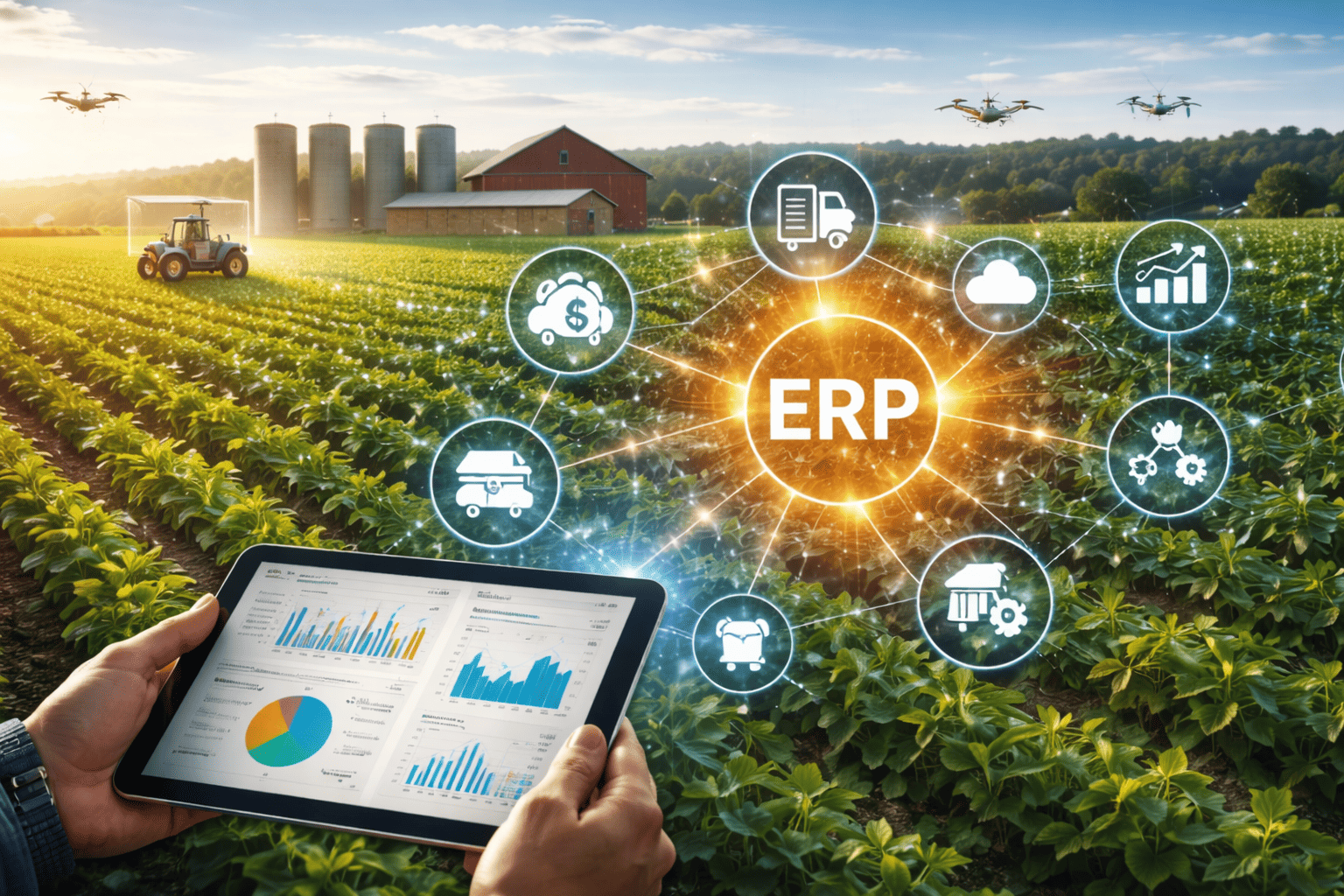
In a rapidly evolving business landscape, organizations can no longer rely on fragmented, single-purpose applications to drive growth. This is especially true in agriculture, manufacturing, and other industries where operational complexity, regulatory pressures, and data visibility directly influence profitability.
The recent Acumatica discussion on Agriculture ERP vs. Farm Software highlights a critical point: businesses need more than specialized tools – they need unified platforms that not only solve departmental pain points, but also scale with growth, automate processes, and empower real-time decision-making. At Acuvera Tech, we couldn’t agree more.
The Limitations of Traditional Niche Tools
Industry-specific applications – whether for farm management, quality tracking, or supply chain coordination – often excel at solving one problem. But when they operate in isolation, they also create unintended consequences:
- Data resides in silos
- Analytics require manual aggregation
- Teams make decisions based on outdated information
- Growth initiatives become harder to coordinate
These challenges aren’t unique to agriculture – they are pervasive in chemical, life sciences, manufacturing, and distribution sectors as well. We regularly encounter organizations using multiple point solutions that sacrifice integration for specialized functionality.
Why ERP Is More than a Replacement – It’s a Strategic Platform
Modern ERP systems are designed to unify business processes across functions – from finance and inventory to customer management and compliance. Unlike standalone tools, an integrated ERP:
- Provides a single source of truth
- Eliminates reconciliations across disconnected systems
- Tracks performance in real time
- Supports automated workflows across departments
In regulated industries, ERP becomes especially valuable because consistent, traceable data isn’t just a convenience – it’s a compliance requirement. Whether it’s material traceability in manufacturing or batch tracking in life sciences, ERP ensures accuracy without manual workarounds.
Real ROI Comes from Connected Processes – Not Just Short-Term Gains
The Acumatica article underscores how businesses seeking flexibility and future readiness find greater long-term ROI with an ERP strategy. We see this consistently with our clients at Acuvera Tech. Organizations often discover that the real value of ERP isn’t just cost savings – it’s the ability to:
- Respond quickly to market disruptions
- Scale operationally without adding complexity
- Drive efficiency gains across cross-functional teams
- Generate deeper insights through integrated analytics
These outcomes go far beyond what patchwork tools can deliver – especially in environments that demand real-time information and agility.
Integration Is Not Optional – It’s an Accelerator
One of the most significant benefits of modern ERP is the ability to integrate with other applications without creating technical debt. Systems for CRM, warehouse management, planning, or external partners can all connect through standardized APIs, eliminating the friction that isolated software creates.
Acuvera Tech’s Perspective
At Acuvera Tech, our approach isn’t about replacing tools – it’s about elevating how organizations operate. We help businesses assess their current technology stack, identify opportunities for centralization and automation, and implement Acumatica ERP as a solution that delivers both immediate impact and long-term scalability.
If your organization – in agriculture, manufacturing, life sciences, or beyond – is evaluating how to break free from disjointed systems and unlock enterprise-wide efficiency, it may be time to consider a unified ERP strategy. Read Acumatica’s perspective on Agriculture ERP vs Farm Software by clicking on the button below.