
Why Are Industrial Distributors Competing With Amazon Business? What the Right ERP Has to Do With It
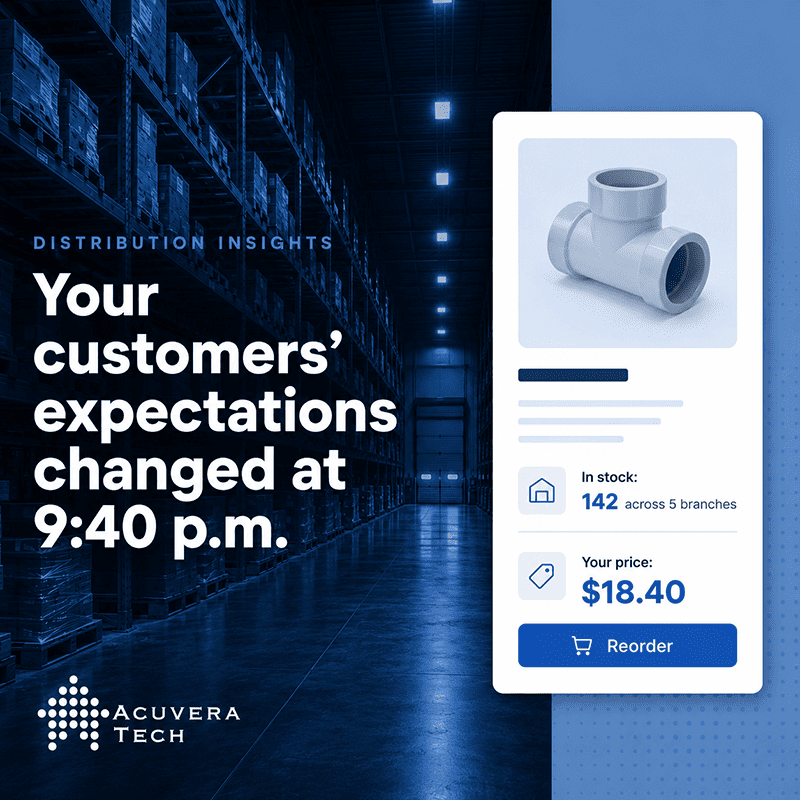
Somewhere in your customer list, a purchasing manager placed an order late last night. The open question is whether or not they placed it with you. If your branch was closed, your webstore couldn’t show their contract price, and your inventory status required a phone call in the morning, there’s a good chance the order went to the supplier that was fully open: Amazon Business.
Mid-market distributors haven’t lost anything on product knowledge, relationships, or service. What’s changed is the buying experience customers now treat as normal.
Amazon Business Isn’t Coming for Distribution. It’s Already Here.
Amazon Business has surpassed $60 billion in annualized gross sales and serves more than 11 million business customers worldwide, according to reporting from Modern Distribution Management and Marketplace Pulse. That’s up from roughly $25 billion in 2021 and $35 billion in 2023. The business has nearly doubled in about three years.
Here’s what matters for a mid-market distributor: Amazon Business isn’t winning on technical expertise, application support, or local availability. It doesn’t have your counter staff, your vendor relationships, or your ability to get a critical part to a jobsite by noon. But it is winning on the experience of buying. It has a search function that works, visible pricing, live stock status, order history, and self-service reordering available 24/7. That experience is resetting what every B2B buyer expects from every supplier, including you, right before our eyes.
The Real Shift Is in Your Customers, Not the Competition
The buyers walking into your branches and logging into your webstore are no longer the buyers of ten years ago. The research on this is consistent and hard to ignore:
- Buyers are comfortable making very large purchases without a rep. McKinsey’s B2B Pulse research found that 39% of B2B buyers are willing to spend $500,000 or more on a single order through self-service or remote channels, up from 28% two years earlier, and 20% would go past $1 million (McKinsey & Company).
- Most buyers now prefer not to go through a rep at all. Gartner’s latest sales survey found 67% of B2B buyers prefer a rep-free buying experience, up from 61% the year before (Gartner).
- Digital channels are where the growth is. Total U.S. B2B sales grew just 0.4% in 2025 as buyers delayed projects and scrutinized pricing, but B2B ecommerce grew 13%, to $2.93 trillion (Digital Commerce 360). In a flat market, the online channel is absorbing the orders.
The uncomfortable implication: your customers aren’t comparing you to the distributor across town anymore. They’re comparing you to the most recent effortless buying experience they had, and for most of them, that experience was Amazon.
Where Independent Distributors Still Win
None of this means the fight is unwinnable. Mid-market distributors hold advantages Amazon can’t easily replicate: negotiated contract pricing built over years of relationship, deep application expertise at the counter, local inventory positioned near the customers who need it, credit terms, jobsite delivery, and the accountability of a business whose owners actually answer the phone.
The problem is that at many distributors, those advantages are invisible online. The contract price lives in a spreadsheet or a rep’s head. Real-time availability across four to seven branches requires a phone call. The webstore, if there is one, shows list price and old inventory. The very things that make you better than Amazon are locked inside systems and people your customer can’t reach after business hours.
The ERP Gap: Why Good Distributors Deliver Frustrating Digital Experiences
When a distributor’s digital experience falls short, the webstore usually gets the blame. In our experience, the webstore is rarely the root cause.
Most underperforming distributor ecommerce setups share the same architecture: a generic ERP that wasn’t built for distribution, with a third-party storefront added on after the fact, and connected by batch syncs. That architecture produces very predictable symptoms.
Three symptoms of an ERP that can’t keep up
- Pricing your customers don’t trust. If your ERP can’t push each customer’s negotiated, contract-specific pricing to the web in real time, buyers see list prices they know are wrong leading them to call, email, or leave.
- Inventory your customers can’t see. Nightly syncs mean the site shows availability from yesterday. One backorder surprise is all it takes to teach a buyer to verify by phone, or to skip the site entirely.
- Self-service that isn’t. If order history, open invoices, quotes, and reordering aren’t online, every routine transaction consumes counter and CSR time your team could spend on higher-value work.
For a CFO, this shows up as cost-to-serve: staff hours spent on order-status calls and price checks that a competent portal would absorb. For a supply chain leader, it shows up as demand you can’t see coming because it’s arriving by phone and fax instead of flowing through a system.
What the Right ERP Has to Do With It
This is why the Amazon Business question is really an ERP question. A storefront can be redesigned in a quarter, but it can’t display customer-specific pricing or live branch inventory that the system behind it doesn’t have.
It’s also why distribution-specific platforms exist. Epicor Prophet 21, the ERP Acuvera Tech implements and supports, was built around exactly the capabilities this gap exposes: native B2B ecommerce that runs on the same live database as the rest of the business rather than syncing to it, a customer-specific pricing engine that presents each account’s negotiated pricing online the same way your inside sales team would quote it, and real-time inventory visibility across every branch, so the availability a buyer sees at 9:40 p.m. is the availability that’s actually on the shelf.
Whether you evaluate Prophet 21 or any other system, the test is the same. Ask three questions: Does ecommerce share one live database with the ERP, or sync to it? Can every customer log in and see their own pricing automatically, without manual maintenance? And is the inventory shown online the same number your branch managers see? A platform that can’t answer yes to all three will keep your best advantages offline, no matter how good the storefront looks.
Compete on What Amazon Can’t Copy
Amazon Business will keep growing, that’s not a question. But it can’t match your expertise, your local inventory, or your relationships. Those are yours and only yours to lose. What will turn the tide now for distributors is making those advantages as easy to access as an Amazon cart.
If you’re weighing where your current system helps or hinders, that’s a conversation worth 30 minutes.