
Five Working Days to Answer a Recall. How Long Would It Actually Take You?
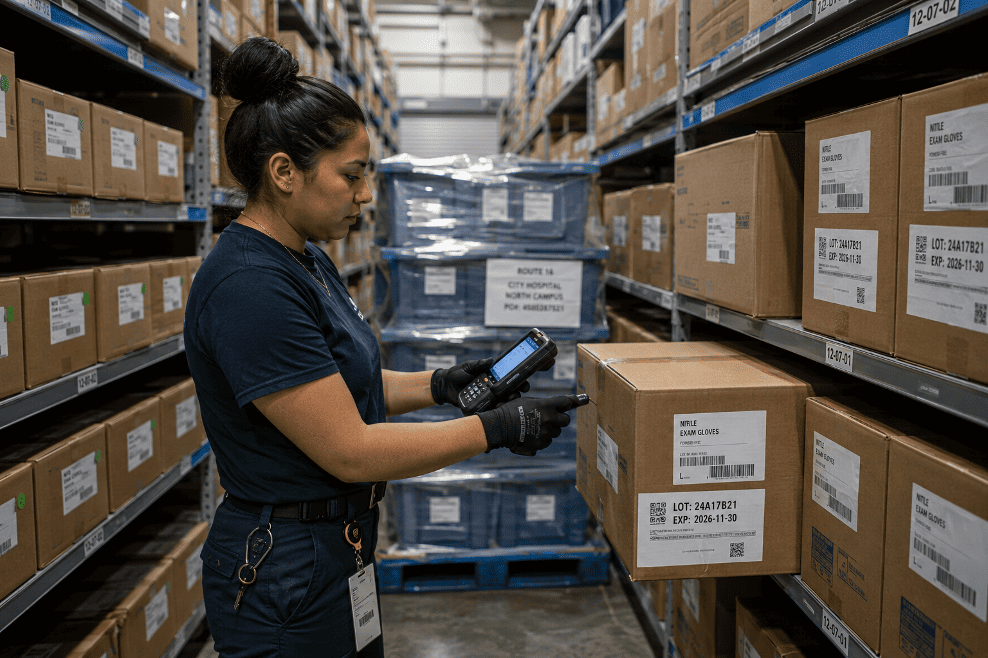
The manufacturer calls on a Tuesday to tell you Lot 88-4402 is being recalled, and they need to know where every unit went.
The answer exists somewhere. The units that shipped clean are in the ERP, but the ones that went out as swaps are in a spreadsheet. Then the two that a rep hand-carried to a surgery center in March are in an email thread. The warehouse manager knows about the rest, but he’s out this week.
You will get the list, no doubt about that. It may take three days and four people, but you will get it and the number you send back will be one you can defend even though it might not be exact.
That call is a systems problem that a compliance event just happened to expose.
Growth stopped hiding the workarounds.
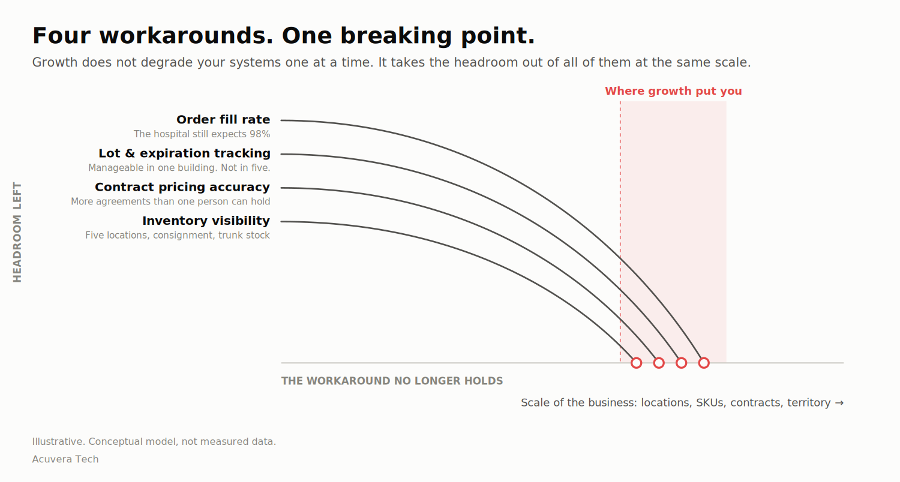
The recall list is slow for the same reason six other things are slow. You won the IDN agreement, added two product lines, and opened a third stocking location. Every one of those was the right decision, but together they pushed four separate things past the point where a workaround still holds. Unfortunately, they all did it in the same quarter.
Inventory visibility went first, because “what do we have” now means five locations, plus consigned stock, plus whatever is in a rep’s trunk. Contract pricing accuracy went next, because the pricing rules one person used to maintain by hand now span more agreements than one person can hold. Lot and expiration tracking went, because it was manageable when it lived in one building. Fill rates went, because a hospital expecting 98% does not grade on a curve for your growth.
None of these failed one at a time. They were never supposed to be four systems. They were one system, and the system was a person.
You may be exempt from registration, but you are not exempt from the phone call.
A wholesale distributor that does not manufacture, repackage, process, or relabel is expressly excluded from FDA establishment registration under 21 CFR 807.20(c). That exemption gets misread as a general pass, but it’s not one.
Under 21 CFR 803.18(d), you have to keep incident files for complaints alleging a device deficiency, identified as such, filed by device name, at your principal business location, for two years or the expected life of the device, whichever is longer. FDA can inspect and copy them. Under 21 CFR 7.49(d), a consignee receiving a recall communication is expected to act on it immediately and extend the recall to its own customers where necessary. And for any device under an FDA tracking order, 21 CFR 821.30 gives you five working days to answer the manufacturer and ten to answer FDA, with lot or serial number, date received, source, and disposition.
Five working days. That is the real clock on the Tuesday phone call.
What a distribution ERP does differently
Epicor calls Prophet 21 the only ERP designed by distributors for distributors. Setting the superlative aside, the practical difference is where the data comes from. A general-purpose ERP asks you to build medical distribution on top of it, while P21 starts there.
Lot traceability is native. Lots carry their own attributes, and the warehouse scans item, bin, lot, and serial on every movement, so genealogy accumulates as a byproduct of picking instead of as a reconstruction project. The recall answer becomes a query.
Multiple locations are treated as normal, not as an upgrade. The 2026.1 release adds enterprise reporting hierarchies: define the business by region, group, and location, tie each user to the level they are cleared to see, and reporting rolls up without anyone rebuilding a spreadsheet every month.
Pricing becomes auditable. 2026.1 introduces a Price Audit option in Sales Pricing Inquiry showing how the system arrived at the price on a given item. When a customer disputes a contract line, the useful question is not whether the price is wrong. It is why. That is now answerable on the call.
Two more worth knowing. Epicor Prism uses large language models and retrieval-augmented generation to answer plain-language questions against your ERP data, and its ECM agent cites the documents behind the answer. Grow AI Item Advisor applies machine learning to your own buying patterns to suggest complementary items during order entry, which is margin you already earned and were not capturing. Neither one is a strategy. Both take work off the people carrying too much of it.
Why Acuvera Tech
We are an Epicor Platinum Partner. Our consultants are ERP professionals with roots in distribution, so you will not waste the first month explaining consignment, or why a missed fill rate costs more than the line item it sat on. And we follow a defined, repeatable implementation methodology, which in a business built on service-level commitments is not a nice-to-have. It is the risk control.
One ask
If the Tuesday phone call is familiar, come talk to people who have made it stop being a three-day event.
The Epicor Distribution Leadership Summit brings distribution leaders together around exactly these problems: visibility across locations, traceability that holds up under scrutiny, and growth that does not cost more than it earns. It is the only thing we are asking you to do with this post.